Louise Landes Levi

A Eulogy for Simon Vinkenoog:

Shamaniam, Prophecy, & the Poetry of the 20th Century

This eulogy was previously published in Unlikely 2.0 and is posted here courtesy of Louise Landes Levi.

‘ je leven een vuurwerk of niet …’

[Editor’s Note (from Unlikely 2.0): On 12 July 2009, the world lost Simon Vinkenoog: poet, writer, and icon of the Dutch counterculture. In October, he was honored at the Buddhist Film Festival Europe, at which Louise Landes Levi read this eulogy. Following the eulogy, we reprint Simon Vinkenoog’s translation of the classic Tibetan poem “The Quest of Milarepa,” along with an English translation from Technicians of the Sacred (ed. Jerome Rothenberg, University of California Press, 1985]

If I write
or speak about Simon,
it is not as a disinterested witness. Simon was friend, fellow translator, teacher, colleague, at times unwilling parent, certainly a partner in crime
for the four decades that I was privileged to know him.

I befriended his wives —
one was by the time of our meeting, his neighbor: Reinike, graceful & empowered, I had seen her on the market, a women who was a stranger & yet an Amsterdam icon of the era, Barbara, muse & friend, translator of my first book into Dutch, mother of Simon’s youngest children — Arthur & Anna —
&
finally Edith, his long awaited partner, Simon’s soul mate
with whom he lived for the final 22 years of his
life, a partnership celebrated both for its
duration & for its quality
of inspired love.
*
What
differentiates the shaman from the prophet & finally these two from the poet?
The three roles of course, overlap & can, to a certain extent,
elucidate Simon’s passionate elocution
within the perimeters of post war
Dutch society,

The poet is subject to a certain clairvoyance — at certain times, his poetry or hers will function in prophetic ways which are not always intended,
at least not consciously so.

The poet maps his providential world,
creates landscapes in which his or her deepest aspirations can be aligned, indeed pursued, through text, if not in direct action
&
yet, Simon
functions as social activist, creator of dream, he is a last
vestige for the idealism that prevailed after the Second World War — well before we understood that the officials of the Third Reich had not been punished but hired
by the allied powers, who superficially opposed them,

Simon
stood for the values of the fallen land — maternity, generosity, freedom of thought, freedom of speech, freedom of the press. Whatever singularities separate the poet from the shaman & the shaman from the prophet, none of those three would agree to the censorship,
which has become the handmaiden of the so—called
democratic societies.

Simon
was not a rich man,
He lived for his work for the greater part of his life & was his
work, he served the people of Amsterdam & by extension, within the Dutch speaking community. the country. He taught & demonstrated the power of Love to the impoverished, the jailed, the marginals, the seekers — To literary & artistic icons — with whom he was equally both at ease & eloquent he taught, as demonstration & by extension of his autodidactic method, the literary tradition of the lowlands
& the visionary prerogatives that
perpetuated it.

For him
Jan Luyken —‘Soo dat ick u, o Godt! bevondt, Te zyn den grondt wan mynen grondt’ — Guido Gizelle
O Lied O Lied & Johny van Doorn, Jules Deelder
Remco Campert Hans Vlek Arie Visser
lived in a single moment of
poetic inspiration.

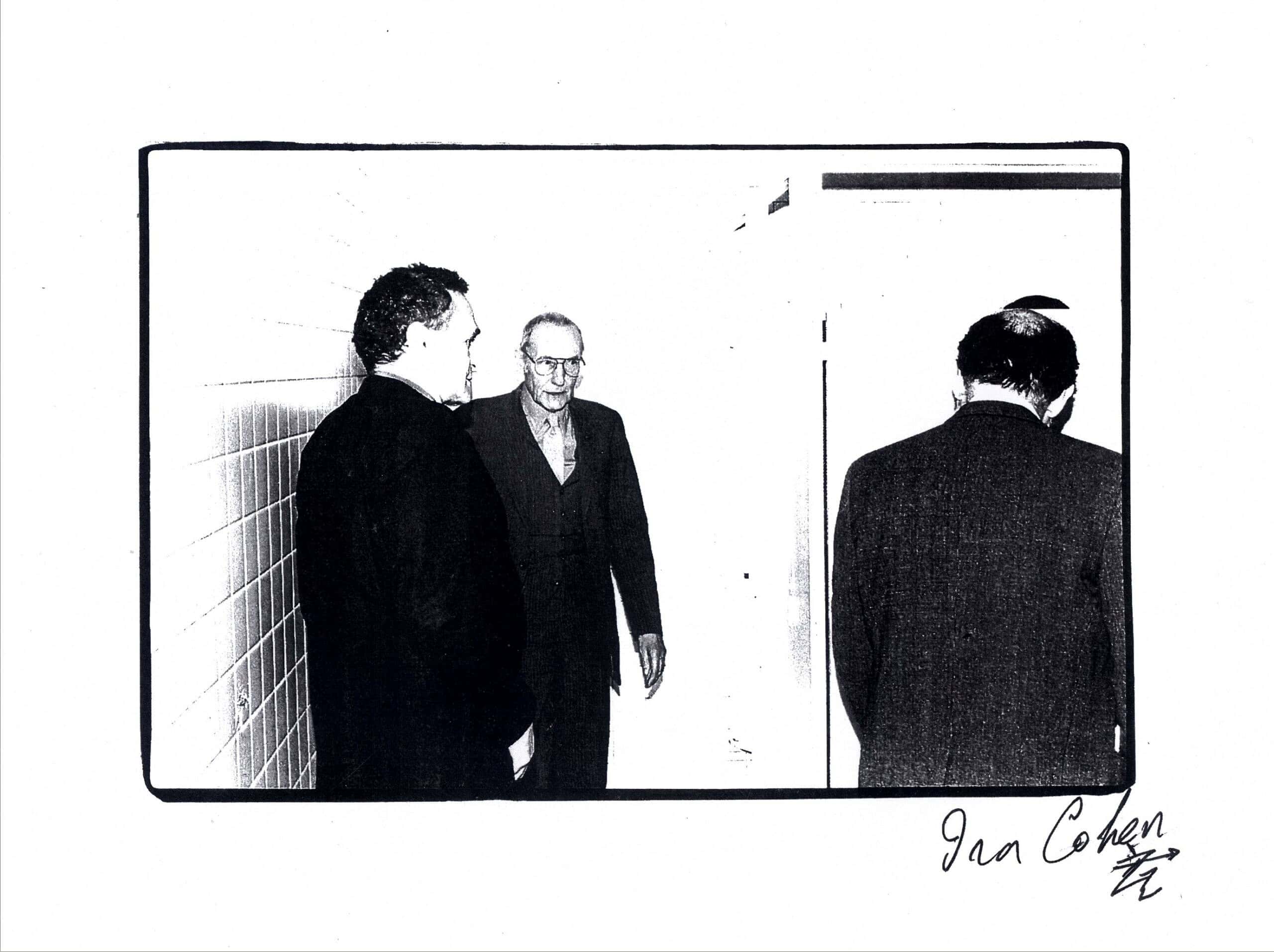
William Burroughs, Ira Cohen, Timothy Leary, Allen Ginsberg,
his translations of whom were as good as the original— ‘fuck me mijn master’ — as anyone who heard them read together will attest — brought the avant-garde through the dykes which separated 20th century Dutch expression from the world beyond those dykes.

The prophet of the social realms reaches into the utopian
traditions & creates it for his time. The shaman, by definition, liberates
his listener, the qualifications between chant (or mantra), song & the common word are absolved. The shaman uses all three to fulfill his energetic role & to liberate
from delusion those who are governed by delusion.

The poet is craftsman of ancient spraak — etymology — he must use
his language both as contemporary dialect & as craftsman.

In Simon’s evolution as poet & spokesman,
these roles so interrated that his power to provoke often overruled his daily labor, his dedication as translator of more than 40 volumes, as journalist, poet — investigateur of the secret & even banished realms & as craftsman,
student indeed of the Dutch tradition.
For these qualities, we thank him.

For his endurance as a friend in my life,
I thank him. For championing me, at a time, when I could easily have been neglected in a foreign land, for reaching into his experience — his own victimization in the Second World War — for rescuing a second-generation Jew, equally victimized, secret pact — May tears shed at his departure bathe the deeper level of my confusion — that I may aptly stand to read the following translation — written by Paul van Ostaijen—translated by Simon & myself— some 30 years ago:

So, the beloved
         Mitri Karamzov
          also dies,
        Now on our shoulders,
         Late and slanting, the shadow
       of Ivan, falls.

      Become grateful for suffering,
       and seemingly, joyful,
       the sharp fight of spider and bee
      and the awaiting.

At time my hand is already closed
        as if there lay no longing
         over my fingers,
         It is a far way
          to the passionless mountain

            Logos
                   Tao —

The last time I heard Simon read, was on the Churchill-laan, Dec.8th 2008—
it was raining, a cold night of winter. I, an occasional visitor,
knew little about the pain he endured.

Edith
in the driver’s seat, the car traveling through night rain, Simon
finally upright, in front of the statue of Gandhi

‘Verdom de Oorlog, Beziel de vreede’

were the words on the t shirt, his favorite, in which he was buried,

His voice clear, his elocution perfect, his
rendition of one of the one hundred thousand songs of Milarepa,
beyond my capacity to describe. I was not to hear him read again — but am
grateful to that rainy night, to the Tibet support group who
were smart enough to ask him to catalyze the energies
of the evening & to Edith, his constant companion,
for getting us there in such inclement conditons
& who ‘by serving one man’
as she often said ‘served the world’,
but also his personal circle — his extended family & friends,
an intimate world of intrigue, intellect & service,
unknown to journalists
but
well known to those who followed
www.kersvers.com [now SimonVinkenoog.nl]

In the Tibetan tradition, there is sub-sect of the ‘Red Hats’
The Karma Kargyus —called the Drupka Kargyus. I have been fortunate to study with the titular head of this sect,
Namkhai Norbu
Tinpoche

A
Tibetan saying is:

Half of the Kargyus are Drukpas, half of the Drugpas are madmen
& half of the madmen are the greatest poets & painters in Tibet


Simon kept an open house & an open heart, for as long as he was able. I saw him exercise unimaginable patience ksanti & dana generosity with his unusual guests,
Peter Orlovsky, Gregory Corso, Vali Meyers,
Aldo Piramelli & Petra Vogt to name only a few.

Crazy Wisdom yogis & yoginis
signature—adepts of the Drukpa kargyu school—
manifest to heal the contradictions, dualism & pain of our samaroic vision,
freeing us from the ordinary to perceive the inherent wisdom
of non dualistic, non judgemental, non rational open mind.
Simon functioned in this broader visionary landscape
& yet maintained a firm pulse on events surrounding him & us.

Everyone
understood that Simon Vinkenoog was extraordinary
but no one could point out the exact nature of his genius —
looking to the East, the tradition of the Crazy Wisdom
yogi can thus inform us.

I
close by reciting
the mantra of the peaceful deities —
from the xiltrol practice kindly transmitted to me by my teacher
&
how many times did Simon,
& his family wish me well as I departed
by foot, by bus & by train
to the place of refuge.

OM AH HUNG
BODDHICITTA MAHA SUKHA
JNANA DHATTU

A


De zoektocht van Milarepa

Translated by Simon Vinkenoog

1
Naamgegeven ben ik de man terzijde;
Ik ben de wijze van Tibet;
Ik ben Milarepa.
Ik hoor weinig maar geef veel raad;
Ik hekel weinig maar volhard veel;
Ik slaap weinig maar verdraag veel in meditatie.
Mijn smalle bed verlicht mijn strekken en buigen;
mijn dunne kleding houdt mijn lichaam warm;
mijn karige kost bevredigt mijn maag.
Door éen ding te kennen ervaar ik alle dingen;
alle dingen kennende begrijp ik dat ze een zijn.
Ik ben het doel van elke grote yogi;
Ik ben de plek waar gelovigen bijeenkomen;
Ik ben de spoel van geboorte en dood en verval.
Ik heb geen voorkeur voor enig land;
Ik ben nergens thuis;
Ik heb geen provisiekast voor mijn levensbehoeften.
Ik ben niet verzot op materiële zaken;
Ik maak geen onderscheid tussen rein en onrein in voedsel;
Ik heb geen behoefte aan kwelling of beproeving.
Ik heb generlei verlangen naar zelf-respect;
Ik heb geen bindingen of vooroordelen;
Ik heb de vrijheid van Nirwana gevonden.
Ik ben de trooster van de vergrijsden;
Ik ben de gek die de dood als geluk rekent;
Ik ben de speelkameraad van kinderen.

2
Toen het tijgerjaar ten einde kwam
En het jaar van de haas begon
op de zesde dag van de maand van de blaffende vos,
had ik genoeg van de dingen van deze wereld;
en in mijn hunkering naar eenzaamheid
bereikte ik de heilige woestijn van Berg Everest.
Toen gingen hemel & aarde samen te rade
en stuurden de wervelwind als boodschapper uit.
De elementen van wind & water ziedden
En de donkere wolken uit het zuiden rolden samen aan;
de zon en de maan werden gevangen genomen
en de achtentwintig maanstanden werden samengebonden;
de acht planeten werden in hun omloop vastgeketend
en de zwakke melkweg in slavernij genomen;
de kleine sterren werden volkomen in de mist versluierd
en toen alle dingen bedekt waren naar de aard van de mist
viel negen dagen & negen nachten de sneeuw.
Gestaag en overal de achttien tijden van dag en nacht viel zij.
Als het zwaar sneeuwde waren de vlokken zo groot als vullingen van wol,
En vielen zwevend als gevederde vogels.
Als het licht sneeuwde waren de vlokken zo klein als spoelen,
En vielen cirkelend als bijen.
Dan weer waren zij zo klein als erwten of mosterdzaad,
En vielen zich kerend als deernen.
Bovendien overtrof de sneeuw elke maat in diepte,
De top van de witte sneeuw reikte hoog in de hemelen
En de bomen van het woud beneden werden neergebogen.
De donkere heuvels werden gekleed in wit,
IJs vormde zich op de golvende meren
En de blauwe Tsangpo werd in zijn diepten bedwongen.
De aarde werd als een vlakte zonder heuvels of valleien,
En als natuurlijk gevolg van zo’n grote sneeuwval
werden de mensen opgesloten;
Hongersnood kwam over het viervoetig vee,
En vooral de kleine herten vonden geen eten;
De gevederde vogels daarboven ontbrak het aan voedsel,
en de marmotten en veldmuizen beneden verscholen zich in hun holen;
de kaken van de roofdieren werden samengekneld.
In zulke angstaanjagende omstandigheden
trof dit vreemde lot mij, Milarepa.
Het waren deze drie: de sneeuwstorm die van hoog daarboven omlaag joeg,
de ijzige midwinter windvlagen,
en de lap van katoen die ik, de wijze Mila, droeg;
En tussen hen verrees een geschil op die witte sneeuwtop.
De vallende sneeuw smolt tot fris water;
de wind, hoewel machtig ruisend, nam uit zichzelf af,
en de lap van katoen laaide op als vuur.
Leven en dood worstelden daar op de wijze van kampioenen,
en zwaarden kruisten zegevierende slagen.
Dat ik daar het heldhaftig gevecht won
zal een voorbeeld zijn voor alle gelovigen
en een waarlijk voorbeeld voor alle grote contemplatieven;
bovenal zal het de grotere excellentie bewijzen
van de simpele lap van katoen & de innerlijke hitte.

3.
Dat de witte ijstop van Tisé, groots en befaamd,
Slechts een berg is bedekt met sneeuw,
Bewijst de witheid van Boeddha’s lering.
Dat het turkooizen meer van Mapang, groots en befaamd,
water is waardoorheen water vloeit,
bewijst de ontbinding van alle geschapen dingen.
Dat ik, Milarepa, groots en befaamd,
een oude en naakte man ben,
bewijst dat ik verzaakt heb & niet gericht ben op eigenbelang.
Dat ik een zanger van kleine liedjes ben,
bewijst dat ik geleerd heb de wereld te lezen als een boek.


The Quest of Milarepa

1.
When named I am the man apart;
I am the sage of Tibet;
I am Milarepa.
I hear little but counsel much;
I reflect little but persevere much;
I sleep little but endure in meditation much.
My narrow bed gives me ease to stretch and bend;
my thin clothing makes my body warm;
my scanty fare satisfies my belly.
Knowing one thing I have experience of all things;
knowing all things I comprehend them to be one;
I have experience of true reality.
I am the goal of every great mediator;
I am the meeting place of the faithful;
I am the coil of birth and death and decay.
I have no preference for any country;
I have no home in any place;
I have no store of provisions for my livelihood.
I have no fondness for material things;
I make no distinction between clean and unclean in food;
I have little torment of suffering.
I have little desire for self-esteem;
I have little attachment or bias;
I have found the freedom of Nirvana.
I am the comforter of the aged;
I am the madman who counts death happiness;
I am the playmate of children.

2.
When the tiger-year was ending
and the hare-year beginning
on the sixth day of the month of the barking of the fox,
I grew weary of the things of this world;
and in my yearning for solitude
I came to the sanctuary wilderness, Mount Everest.
Then heaven & earth took counsel together
and sent forth the whirlwind as messenger.
The elements of wind & water seethed
and the dark clouds of the south rolled up in concert;
the sun and the moon were made prisoner
and the twenty-eight constellations of the moon were fastened together;
the eight planets in their courses were cast into chains
and the faint milky way was delivered into bondage;
the little stars were altogether shrouded in mist
and when all things were covered in the complexion of mist
for nine days & nine nights the snow fell,
steadily throughout the eighteen times of day and night it fell.
When it fell heavily the flakes were as big as the flock of wool,
and fell floating like feathered birds.
When the snow fell lightly the flakes were small as spindles,
and fell circling like bees.
Again, they were as small as peas or mustard-seed,
and fell turning like distaffs.
Moreover the snow surpassed measure in depth,
the peak of white snow above reached to the heavens
and the trees of the forest below were bowed down.
The dark hills were clad in white,
ice formed upon the billowing lakes
and the blue Tsangpo was constrained in its depths.
The earth became like a plain without hill or valley,
and in natural consequence of such a great fall
the lay folk were mewed up;
famine overtook the four-footed cattle,
and the small deer especially found no food;
the feathered birds above lacked nourishment,
and the marmots and field-mice below hid in their burrows;
the jaws of beasts of prey were stiffened together.
In such fearsome circumstances
this strange fate befell me, Milarepa.
There were these three: the snowstorm driving down from on high,
the icy blast of mid-winter,
and the cotton cloth which I, the sage Mila, wore;
and between them rose a contest on that white snow peak.
The falling snow melted into goodly water;
the wind, through rushing mightily, abated of itself,
and the cotton cloth blazed like fire.
Life and death wrestled there after the fashion of champions,
and swords crossed victorious blades.
That I won there the heroic fight
will be an example to all the faithful
and a true example to all great contemplatives;
more especially will it prove the greater excellence
of the single cotton cloth & the inner heat.

3.
That the white ice-peak of Tisé, great in fame,
is just a mountain covered with snow,
proves the whiteness of Buddha’s teaching.
That the turquoise lake of Mapang, great in fame,
is water through which water flows,
proves the dissolution of all created things.
That I, Milarepa, great in fame,
am an old and naked man,
proves that I have forsaken & set at naught self-interest.
That I am a singer of little songs,
proves that I have learned to read the world as a book.

Hakim Bey’s BLACK FEZ MANIFESTO, &c.

reviewed by Louise Landes Levi

This review was previously published in Arthur Magazine and is posted here courtesy of Louise Landes Levi.

BLACK FEZ MANIFESTO, &c. by Hakim Bey
(Autonomedia & Garden of Delight, Brooklyn & Dublin, 2008)
Reviewed by Louise Landes Levi

“Come to Prayer – prayers are better than sleep” Dawn Azzah
“But the sleep of the Knowers is worth more than the prayers of the merely pious” Hadith

Most poets have secret arts and even ‘professions’ that are not part of the official biography. The author of the book I’m about to ‘review,’ to take an example, is (I have heard from a reliable source) an excellent billiards player. One wouldn’t want to encounter him casually at a pool table, no. For my part, those who know me well will, on occasion, show me their palm and ask for a reading. Apparently a line beneath my right index finger indicates a propensity of this sort, or so I was told in Bombay. And why not, a line is a line, a line of verse or a line stretched across the mortal palm.

Earth needs more parking lots
the way you need more patches of asphalt
grafted to your face & genitalia

(from Shoe Dream)

Esoterically, the chakras open, it is said, intuition reads through the labyrinth (of lines). Is this so different than reading a text? And the billiard player—is his first thought best thought to be doubted? The archer and his arrow, the pool player and his cue. We take the cue from Hakim Bey, aka Peter Lamborn Wilson, a national treasure, hidden, of course, but thankfully through publications of this sort and the dedication of publishers Autonomedia and Garden of Delights, in view.

In the back room of an
occult bookstore
near the Pantheon a groupuscule called
ZARATHUSTRAS REVENGE concocted the
bomb plot but
the infernal device turned out to b
a dud but regret
is at least an emotion. I was there
& I am still there
a ghost to myself.

Personally I never go anywhere without a book by Hakim Bey, in tow. How many blessed moments reading through T.A.Z.: The Temporary Autonomous Zone, Pirate Utopias (then and now, on Isla Margarita not far from Santa Anna, a small village settled by Spanish version of same, holy drop outs, some hundreds of years ago), Avant Gardening, Millennium, Shower of Stars: The Initiatic Dream in Sufism and Taoism, such an esoteric and beautifully written book; and the poems, recent chapbooks, rain queer and The Atlantis Manifesto and those found, almost by chance in an anthology, to name one among many, Wildflowers No. 7 (Shivastan, 2007) or the recently published translation from the Persian Il divan-al-Ghalib (Longhouse, 2009).

Civilization in ruin is always a good idea.
Industrial decay has the same
beauty as Persepolis – the melancholy
of vast suffering ended & barely
remembered, like dental pain.

(from To Shelley, an Instasonnet)

HB’s verbal presentation of the poems is, to say the least, an art apart. Declamation, no, a lecture, in the style of the didactic, definitely not, a mild reading of verse to comfort and align the chakras and channels, no, tranquility seekers, go outside and stargaze. Hakim Bey (aka PLW) is a shaman, and he plays his drum and his role wherever and whenever he can.

Chamomile & melatonin
poppies & hot milk
milk with a skinskim
of yellowish cream

beneath a quilt stuffed with Indian grass
in a hammock of Indian Summer
with a pillow blessed by ibn Sereen
the Father of Islamic Oneiromancy on

an island of lotus esters
soporific with ebony halls of
silent black marble & moonlight
highlighting the limbs of Hermaphroditus

‘assumes the shape of an egg’
& performs the opposite of hatching

(from Somnium)

He has, therefore, developed a unique reading style. It is everyone’s privilege, and especially the lovers of his poetry (and his mind) to listen to and to behold it.

Cloistered alone round the faded hearth
Sweeney thinks he remembers being
driven woodsqueer eating watercress & nettles
till he became a kind of green man
himself. The college bell rolls emptily
Tristan Tristen driven frantic with
love potion flees to the forest
filthy & naked. Was that me?
Surely the zoning code would
forbid it or rangers would soon come round
with citations for violating
protected wilderness. Surely by now
I’d be in therapy no longer bothered
by Isolde or the horrors of war.

(from Mad Sweeney)

Black Fez Manifesto is a collection of brilliant antidotes, an encyclopedia of esoterica so complex a conventional review cannot possibly cover the terrain. A film containing this broad range of imagery, symbol and historical allusion, would last a few days at least. PLW does not assert a new paradigm; he does not uncover concealed truths, or those, held by ‘tradition’ (i.e. secular or ‘spiritual’ authority) to be so. He is not constructing a religious metaphor and certainly not a cult, heaven forbid—even hell would forbid such an attempt (on his part).

The Enlightenment is a Good Ship Lollipop of which
we’re the ratites norvegicus scuttling
ashore in rain-light sighing sauve qui petu.
Our guru knew that Dr. Brink of Kingston
his enchanted forest now reduced to a few
tombstones in a suburban back yard backed
up to the exit ramp for route 202
will supply us with graveyard grisgris
quack-spagyric brews & slews of roots
& simples.

(from Dr. Brink 1754 – 1843)

HB deconstructs world history and places it at our disposal. His deconstruction is, however, not ‘postmodern,’ there is too much esoteric knowledge, and indeed mastery, for us to simplify in this way. HB is not reducing knowledge.

The days are our slaves
We set up maquiladoras on the Moon
An albine Persian cat
Watch yr. fingers the Sun’s dog’s
Convorting with its little pal
Nicola Tesla.

(from Dog of the Sun)

He is putting it together as an entirely new script or anti-scripture (and not one which requires linear analysis, i.e. logical derivation). For, it is true, if we haven’t seen it until now—when will we?

People of the Future are reading us
now & envying our thenness
blighting our crops & wilting
our infants, gnashing their gaze
over our intimacy with species long extinct.

(from Creepy Sensation)

As those who have even casually read his work know, HB is concerned with the Neolithic, so it is to be expected that a great deal of botanical reference weaves its way through the signs and symbols of antiquity, as well as in the post-modern reminders of the decomposition we witness in the social, spiritual and economic ecology of the 21st century.

Invest yr. Bank of Hades billions
in the Imaginal Wall St. of money gone
to heaven. Sipping the
green wines of science fiction with
futures so neoplatonic you can smell them suddenly

(from Financial Sonnet)

For those who have followed the evolution of PLW, & his shadow HB, or the reverse if you prefer, Black Manifesto is another sign or signal, an almost ontological proof of the existence of our local (planet Earth/Solar System, Galaxy Milky Way) genius and friend, for remarkable warmth issues forth from the man, in verse or in person, considering the vast, almost unfathomable erudition he has cultivated in his brief visit to the human realm.

I was pouring over a manuscript of Tocharian B
The sweat of my pores in the dead
oasis of Turfian when suddenly the shilling
in my akashicomter ran out & I
snapped back on silvery umbilical to
the mere here.

(from A Lunar Garden of Legal Phantastica)

For those not familiar with PLW, one might bring along (to one’s favorite café or reading site) a dictionary and an Encyclopedia Britannica, to more easily check citations and references. A glossary would be impossible as the book is a mere 100 pages.

Anarcho-monarchist direct action:
sit on throne facing auspicious direction
doing absolutely nothing.

The wind rose itself can make any
two bit oasis the Mecca
of wayfarers.

Magnetic storms confuse our sense
of direction with pollution across the whole
hermetic spectrum.

I‘ve lost you. You’ve forsaken
the ancient secret of crystal radio
for an alien wavelength

(from Ghazal)

And getting back to Palm Reading, I say to my reader, one of the laws of the profession: never show your hand to someone who is NOT at your level. The reader will enter your secret domain and, the warning implies, if at a lower level, psychically or spiritually (and thus in intent) create havoc. The gloved hand is your protection. I, an acquaintance of the author, took months to write what you have read by this time, simply because of that rule. Forgive me reader, if I have been unworthy of the text and immediately read it yourself to see, one way or the other.
And if by chance you see a white haired gentleman, with a distant yet very warm look in his blue eyes, a nice beard, an altogether attractive ensemble, in the pool room, flee (while your weaknesses – as a player – are still unexposed) because you have met your match. If, on the other hand, your ignorance needs exposure, of a certain sort, greet the gentleman and when you have played your round read Black Fez Manifesto to see what was really going on in the billiard hall.

BLACK FEZ
As emblem of our joint

Intransgient disgust with the lukewarm
Necromanric vacuum of dephlogisticated
corpse breath
That passes nowadays for Empire
& organic death

(from Black Fez Manifesto)

A review of two books from Shivastan Press

by Louise Landes Levi

This review was previously published in Otoliths and is posted here courtesy of Louise Landes Levi.

Independent publishing is an increasing rarity in the corporate dimension in which we are, by the merciless law of the state & the state of affairs in the new millennium, compelled to live and hopefully, despite obstacles, to evolve. Shivastan Press, w. books printed in Katmandu, Nepal & distributed fr. Woodstock, NY, is the rare exception, printing handcrafted finely-illustrated chapbooks by some of the finest poets of our times, both those known & those lesser known.

Ira Cohen has an international reputation as film maker, photographer, story teller & eclectic poet. The treasury of images & the symbolic correspondences to which his mind seems so particularly adapted have found their way into esoteric collections around the globe, but if one is not in the privileged situation of being his friend, his work is not that easy to access. Large collections of his photography are now being published, one, albeit in Germany, Up Close & Personal (Papageien Verlag); but, regrettably, no inclusive collection of his poetry is as yet forthcoming. Each of his chapbooks thus offers a rare glimpse of the poet’s mind, his dedication to the muse & his insight into the mysteries exceeding her.

Whatever You Say May Be Held Against You, handwritten on Nepalese rice paper, is illustrated w. the author’s portrait of Allen Midgette, “the last of the moccasins” (to whom the book is dedicated), several of the poet’s own collages in black & white & a portrait of the poet by Marco Bakker handsomely printed on the black back cover of the rice paper book.

The poems span a broad time cycle, beginning w. Cohen’s seminal work in Katmandu fr. the mid to late seventies, where he also fathered Bardo Matrix Press, in some ways the predecessor to Shivastan, the one in which his work is now represented.

fr. Himalayan Journey

After 15 days/ walking in the Himalayas/we arrive at a strange place (Seta Gompa)/ at nightfall/ my head is empty of all thought/ as I enter the Lama’s room/ filled with great cauldrons/ & charred pots,/ golden ochres,/ Rembrandt browns/ the wood of demon masks/ gleaming under layers of/ smoke & butter/ Outside as the light breaks/ clouds above & below/ like a domed ceiling/ painted by Tiepolo.

Later & more recent poems concern the national & international crisis of 9/ll—(Cohen’s girlfriend is visiting & dreams about the catastrophe the night before it occurs.)

fr. Today’s Headline (May 20 2002)

There’s a sucker born every minute/ is the credo of capitalism/The Age of Reason has come/ & gone/ with the wigs of/ authority & self interest/ It’s not them, it’s US

& the general artistic milieu of NYC, or what’s left of it, when Cohen returns to his mother’s apartment on 106th & Broadway after years of world travel

fr. A Concert of Evening Ragas, in memoriam Pandit Pran

The discovery of poetry as an art of swimming/lucid breath in transparent water/ ...No fear of drowning/ in this ocean of sound.

Many of Cohen’s closest associates—Sheldon Rochlin, Vali & of course Angus MacLise—are given complex & sweet farewell by the poet who eulogizes them. At the same time, he prepares his own mind, w. a warmth that exceeds conjecture, for the inevitable.

fr. Creeley’s Poem

by the time you figure this, that will overtake you/ archaic wonders, my ass, it’s the last inning. Time for some heroics/ Fame is faint in the mirror/ the man in black is my affinity.

Cohen has escaped category & has reason to both rue & celebrate his isolation. I was happy to see a generous selection of his poetry included in Chris Felver’s BEAT & recommend Whatever You Say to those unfamiliar with his work & also, of course, to those who have read his other recent chapbook, Chaos & Glory ( Elik Press). His aggressive script on delicate lokta rice paper will add an additional level of intimacy to the contemplation of his multi cultural & luminous poetic inquiry.

fr. Lost Words

It is the eye of the spirit which opens under water/when you seek you will not find me./ I am already here.

Whatever You Say is a collector’s item.

Shivastan has also published Laynie Browne’s evocation of the perennial philosophy, Original Presence, as part of its wide reaching publication &, in some cases, republication of esoteric works in the context of the late 20th century & the early millennium. Many of its authors—Anne Waldman, Peter Lamborn Wilson, Janine Pommy Vega—spent decades studying & traveling in the Far East, The Middle East & Asia in efforts to comprehend the roots of disaster in the occidental worlds & to first hand, absorb the last traces of the wisdom cultures of the East, even those threatened by consuming winds.

Laynie Browne & her contemporaries, Juliana Spahr, Lee Ann Brown et.al., born in the generation following the above-mentioned, did not take to the road, but stood firm, in their endeavors to create a post-beat sensibility & a new voice with which the greater Feminine might express itself. A generation of women writers emerged in America, 1985 & onward, for whom the Beat generation was NOT a major reference but whose model of collaboration & mutual sustenance nevertheless informed it.

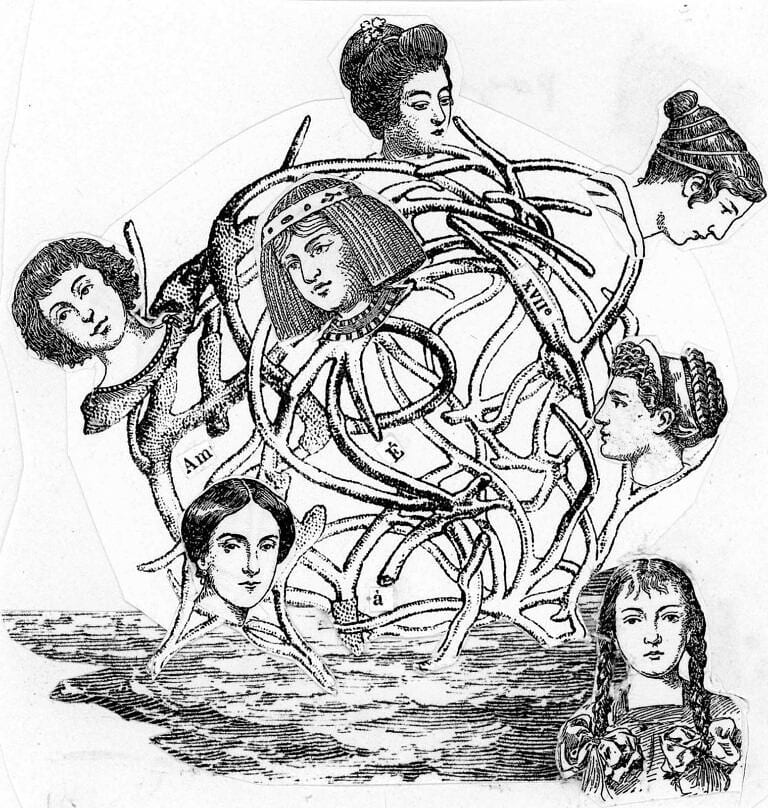
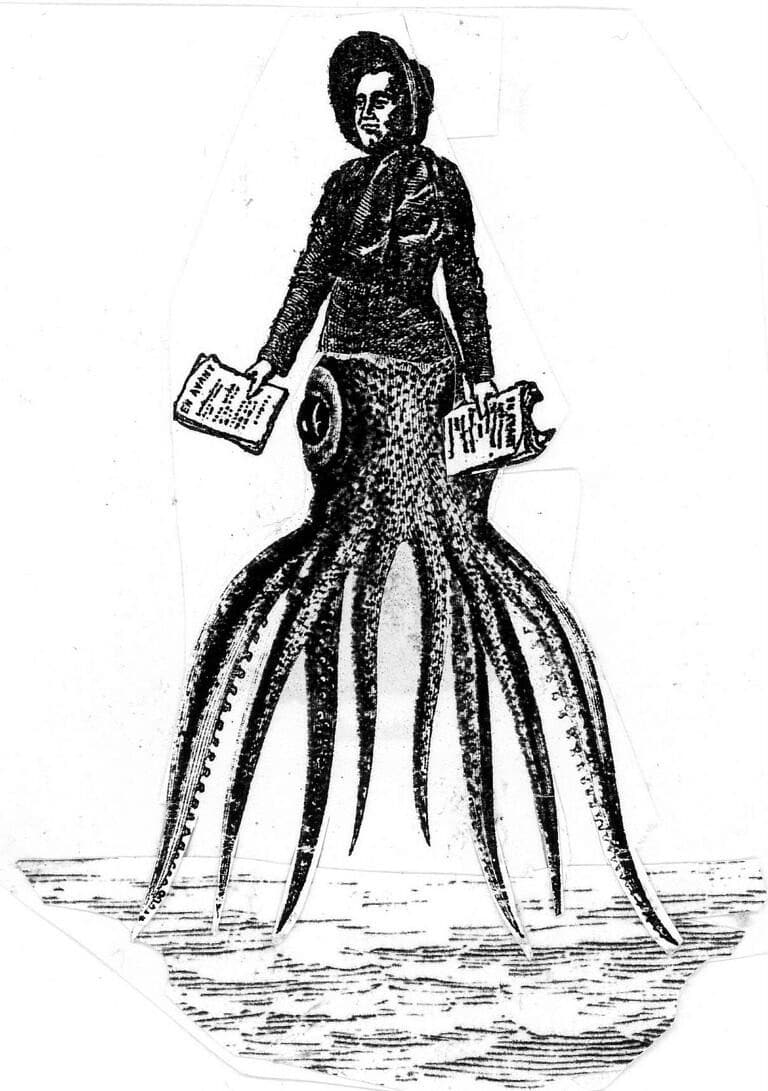
In Original Presence, Laynie travels inward. The book is dedicated to Avram Davis, & the Cabalistic axis upon which the poetic intonation is turning & to which it is tuned is unmistakable. The book is again printed on rice paper & is illustrated w. surreal & poignantly detailed collage by Toni Simon, an illustrator of other works by Brown, Web of Argiope (Phylum Press) & Pollen Memory (Tender Buttons).

Toni Simon: Girls’ Faces

Original Presence is divided into 3 parts: The Girl of Salt, A Quiet Flame & Sudden Inscription. Laynie’s exquisite line, her ability to condense her voice into near crystalline essence is evident through out.

I went to see the girl of salt/ She gave herself to water-/She gave herself to question/ She was nowhere apparent & yet I went to her

Laynie defines, redefines & undefines her search.

The salt girl can reconstitute hersellf and leave the sea/ girl of wax/ girl of paper/ not the watcher/ but the center…

Brown makes indirect reference to hermetic teachings & their language systems but does not depart fr the stylistic innovations that qualify the aesthetic formulations of the century she inhabits. The tensions between the urgency of her meditation, the maintenance of her personal linguistic & the richness of the metaphor she inherits formulate the matrix & mysterious lucidity of this text.

Quiet Flame introduces substance to the seeker’s domain

the candle alone shines of itself and for itself/ practice of the maiden’s chamber/wherever the line is the sand

whereas in Sudden Inscription

Nevertheless, my closed eyelids are encoded with breathing letters/Do you say then language is a garb? A cloth with which to cover the raw head of vowels?

the author reclaims her autonomy.

You write upon my hand as if to say/ Come goblet, come fixture of mind/ Remember the liquid cunning of the sky/Return to my uniform of hands/ pressed upon you/ allowing you to stand.

One reads this book in acrobatic suspension,. sustained in a visionary apparatus, that like all true poetry, is nevertheless tuned to the fundamental of the human harmonic & to its form.

Brown is a master of the postmodern school & sensibility. Those who have followed her work—Rebecca Letters (Kelsey Str.), The Agency of Wind (avec) & Gravity’s Mirror (Primitive Press) et.al.—understand this. In Original Presence we are introduced to an esoteric journey. Brown crosses the divide bringing her study of ancient text to intimate contemporary presence.

Toni Simon: Octopus Woman

Typed script & surreal image, printed on the blankness—at times almost textual—of the rice paper page, bring a third element to the visual field, at times dissolving it completely.


Louise Landes Levi’s The Deep Diamond, portions of which were included in issue two of Otoliths, is forthcoming as a Shivastan broadside.

Shivastan Press books are craftprinted in limited editons of 333 copies in Kathmandu, Nepal, & are distributed by the publisher, Shiv Mirabito, 54 Tinker Street, Woodstock, NY 12498.

A selection of Ira Cohen’s poetry, On Feet of Gold (poems 1968-87), was reprinted in connection w. a photography retrospective at the OCTOBER GALLERY, London, Nov. 2007 – Feb. 2008, & can be ordered on line from the publisher, Synergetic Press.

Laynie Browne´s latest book is Daily Sonnets, published by Counterpath Press, Denver.

Where I Stand in Angel by Louise Landes Levi

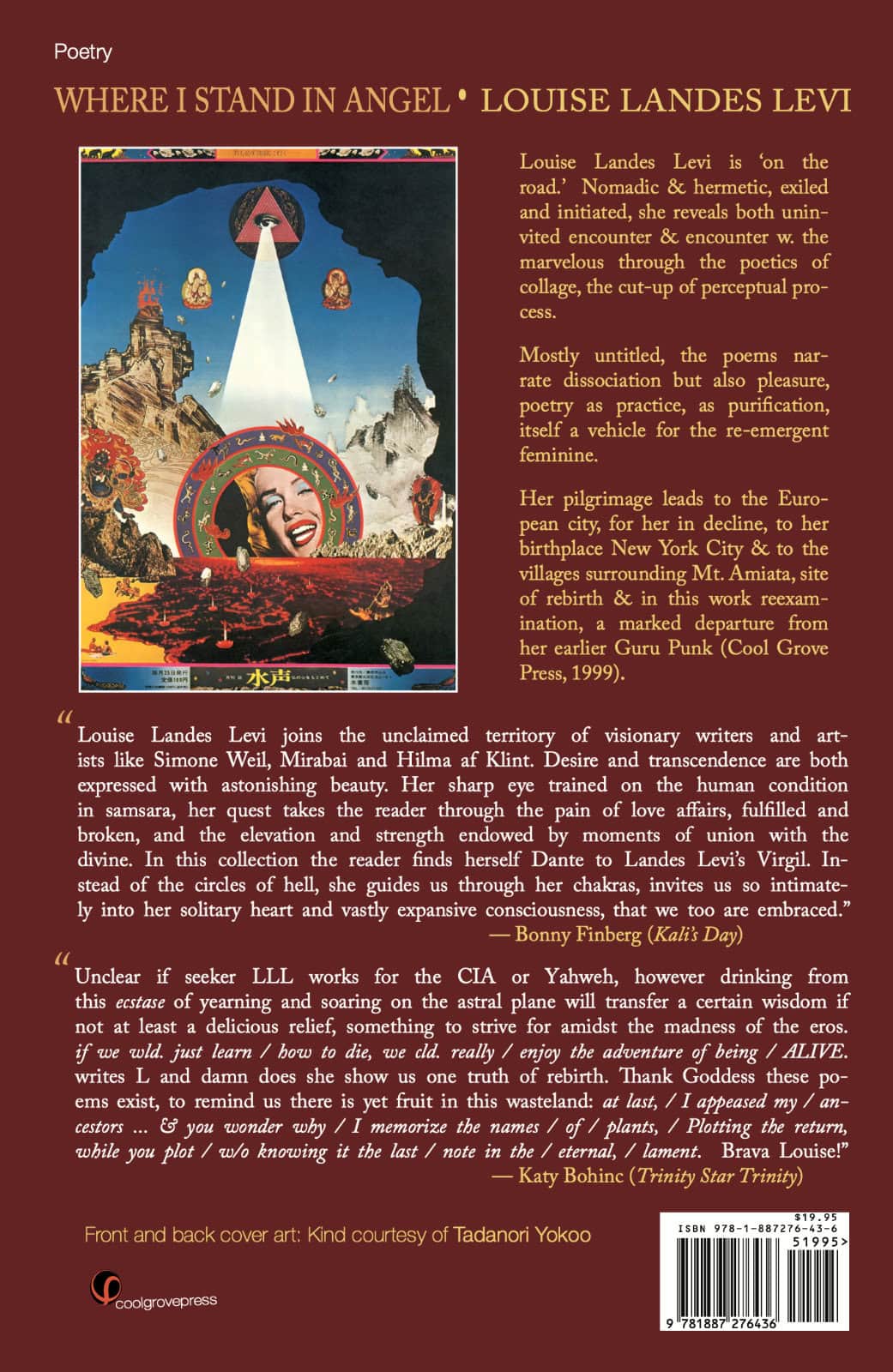
In Where I Stand in Angel, “Louise Landes Levi is ‘on the road.’ Nomadic & hermetic, exiled and initiated, she reveals both uninvited encounter & encounter with the marvelous through the poetics of collage, the cut-up of perceptual process.

Mostly untitled, the poems narrate dissociation but also pleasure, poetry as practice, as purification, itself a vehicle for the re-emergent feminine. (…)”


Vision and Duende in LLL’s Angel

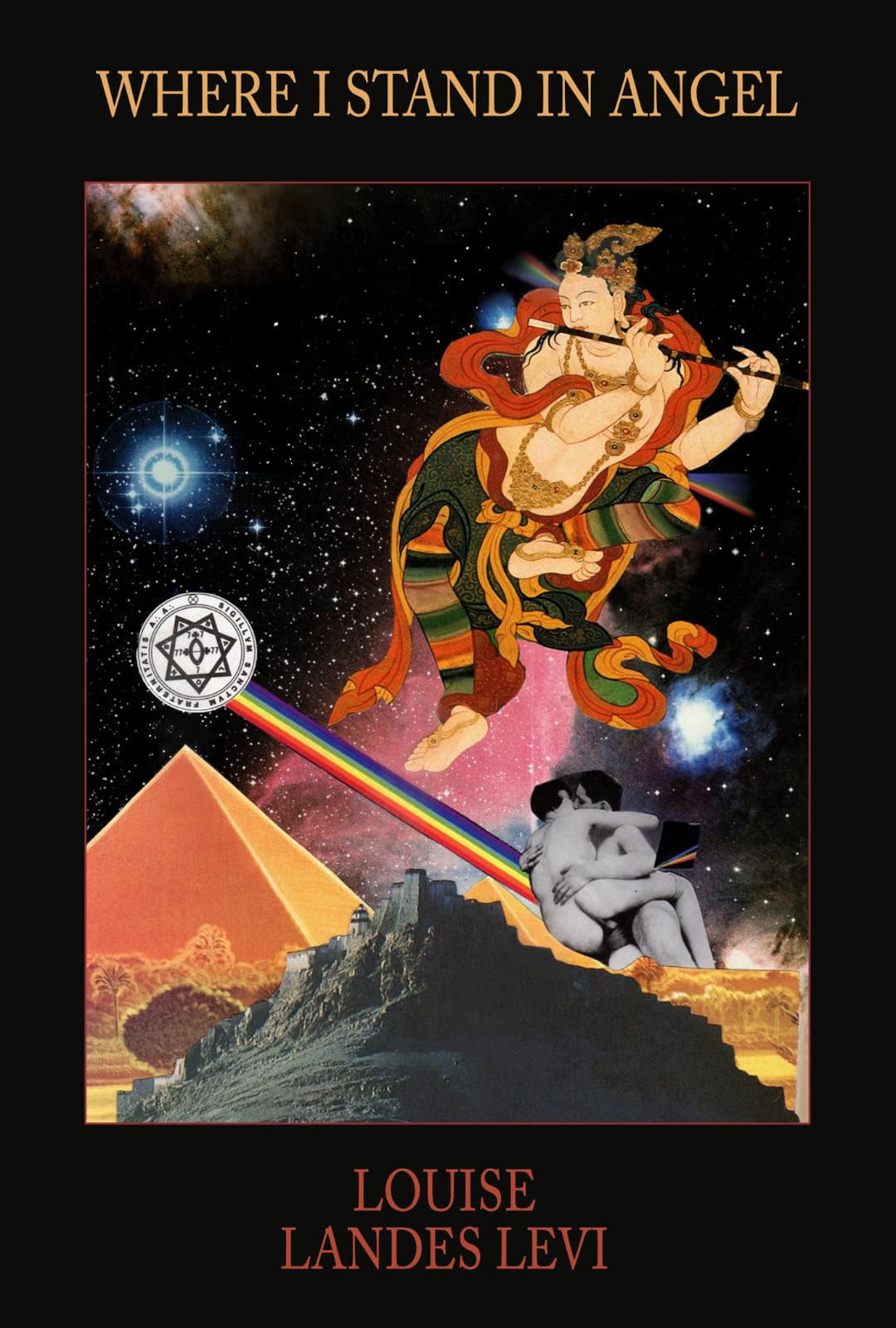
Louise Landes Levi’s Where I Stand in Angel (Coolgrove, 2024) announces itself, in its materiality, as a book of color, vision, and risk. Tadanori Yokoo’s front-cover collage triangulates Jindřich Štyrský’s dark eroticism in Emilie Comes to Me in a Dream with Hindu iconography and Aleister Crowley’s Seal of Babalon. I read Yokoo’s image as doing less to illustrate Louise’s poems than to map a charged field where method, eros, and danger converge. Once seduced into that triple limen, reading Louise comes not as interpretive but participatory.

The title Where I Stand in Angel is itself an out-loud declaration. This book belongs to the same lineage as Allen Ginsberg’s “Kaddish,” where the poet stands at the grave, eye buried, voice calling into Sheol. Like Ginsberg’s cawing cries and black-clouded Eye, Levi’s visions do not console so much as demand presence. The Underworld—announced on the back cover by Yokoo’s collage title, “You Will Definitely Go to Hell” (君も必ず地獄に行く)—appears here less as threat than as passage. A descent that renders knowledge concrete rather than abstract.

These poems insist on juxtaposition for method and exposure for insight. They also invite speculative reversals: What if the collagist were not Štyrský but Emilie herself? What if Kaddish were written from Naomi’s position rather than Allen’s? What if the Scarlet Woman, rather than Crowley, founded the Argenteum Astrum? Such questions are not provocative but structural. Angel re-centers vision from a feminized, embodied position, one dismissed within avant-garde and esoteric traditions. Levi’s stance has less in common with Surrealist urge than with ritual endurance. Where Štyrský’s dream erotics emphasize compulsive return, Levi’s dreamwork, modulated by Chöd practice and tantric descent, induces oblation. Experiences of loss, longing, lament are neither psychologized nor transcended; they are placed into the poem as material to be confronted and, symbolically, devoured. In Angel, the avant-garde and the hermetic are made answerable, but never renounced.

This is where the concept of “duende” becomes difficult to avoid. Federico García Lorca explained that duende does not come from above like an angel. Duende “rises from within, from the soles of the feet.” Levi’s poems are saturated with that energy. Her voice refuses safe distance; it remains in a zone where song entails struggle and vision is inseparable from wound. It is worth clarifying here that documenting injury and romanticizing pain are not one and the same thing. Duende, in this context, names neither aesthetic intensity nor inspiration, but the refusal to leave that struggle and that wound behind. Not just yet, for duende is about danger.

It is perhaps telling that Louise Landes Levi does not appear prominently in many collections of “women Beat writers.” Whether this absence reflects critical oversight or deliberate positioning is difficult to determine. What can be stated with confidence is that Levi’s work operates in direct continuity with Beat commitments to vision and lived practice. Her relative invisibility may be less a failure of recognition than a chosen condition. There is something persuasive in the suspicion that Levi occupies the role of a hidden master, a task that seems to suit both her work and its uncompromising demands. Standing “in Angel” is not elevation but a maintained position at the crossing of worlds, where insight must be earned. Few contemporary poetry books are willing to occupy this space. Fewer still can sustain it without spectacle. Where I Stand in Angel is not, finally, a book to be decoded. It is a rigorous poetic diary—ecstatic, uncompromising, and written with duende.

Antonio J. Bonome,
PhD Lecturer at Universidad Carlos III de Madrid and Beat Generation scholar.


About Louise Landes Levi

Poet, performer, translator and traveler, Louise Landes Levi was born in NYC, studied at the University of California and traveled to India, overland, in the late 60s. Her works on India, recognized classics, decades after their accomplishments — RASA by René Daumal and Sweet on My Lips: The Love Poems of Mirabi — are still in print.

An itinerant scholar & iconoclast, Levi continues to publish, self-publish*, write and wander, translating when requested or inspired and performing, in a wide variety of venues in USA, EU & Japan. She participated in the Burroughs Festival in 2010 University of London, Paris, where the booklet upon which her assertions in the introduction (to this book) were first presented.

A student of Namkhai Norbu Rinpoche for the final 4 decades of his life, she expresses deep gratitude to him for his immeasurable kindness to her. Recent publications include Banana Baby (Supernova, 2006), The Book L (Cool Grove, 2010), Love Cantos 1-5 (Jack in Your Box, 2012), From The Ming Oracle (Sloowax, 2014), Crazy Louise or La Conversazione Sacra (Station Hill, 2018), The Orgasmic Nations (Ragged Lion, 2020) and Behind the Buddha’s Mask (Counter Cultural Chronicles, 2021). Single poems, chapbooks, interviews and reviews are online at Otoliths, Big Bridge, Unlikely Stories, The Brooklyn Rail, The Mirror, Wire and at the Cool Grove Press website. Recent spoken word cassettes: Sacred Remains in the Transformation Station, No Further Than the Nightingale, Opacity and Oblivion. Recent LPs: Ikiru, Kami and Mad Song.

* Levi directs Il Bagatto Press, which originally published ANGEL in an edition of 16 copies, 2 of which are in the Tadanori Yokoo Museum, in Kobe, Japan.

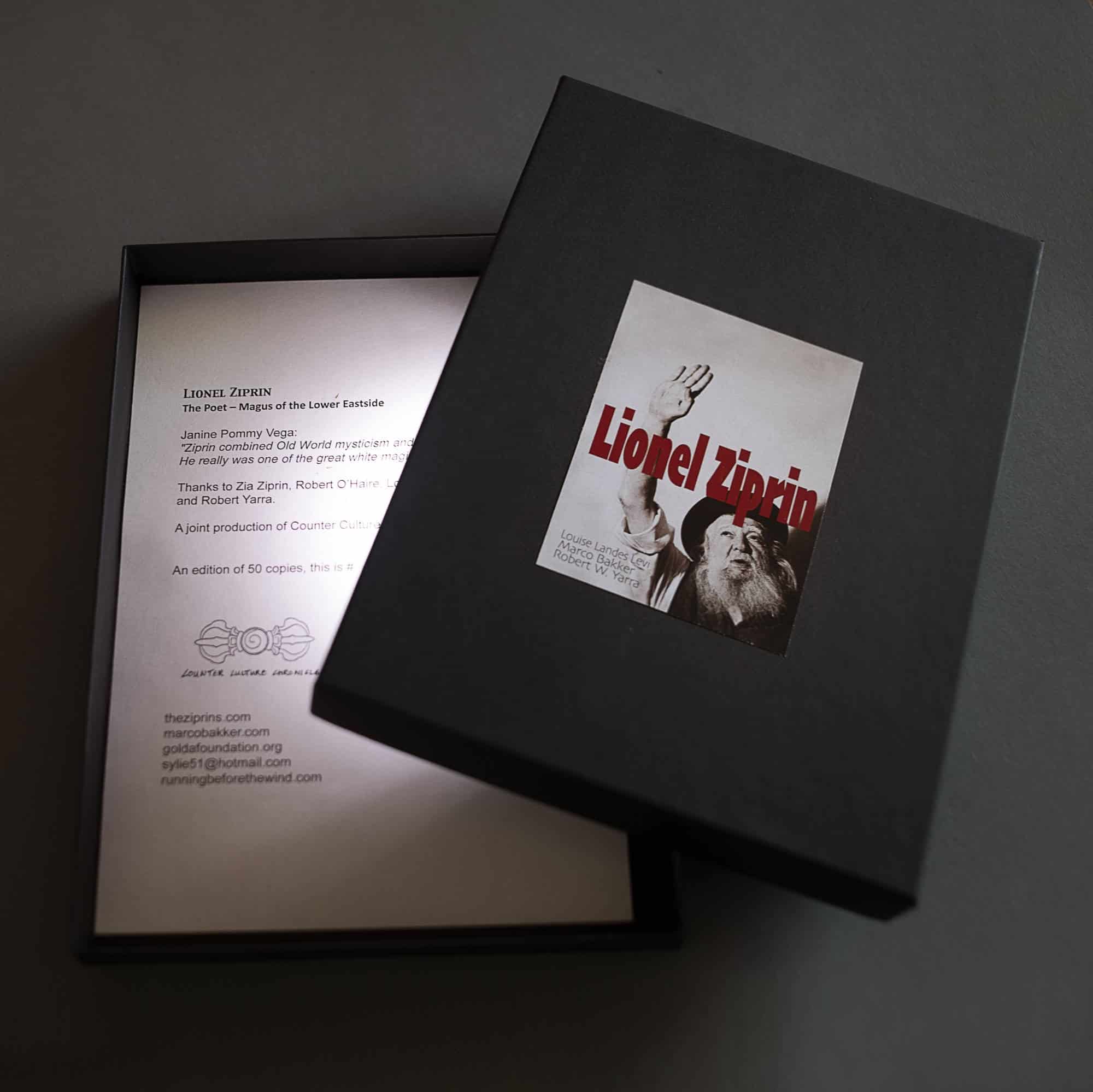
Lionel Ziprin, The Poet-Magus of the Lower East Side

Lionel Ziprin was a prolific writer, a mystical poet who produced thousands of poems in his time, although you wouldn’t be able to tell that from his published output: In 1990 a small wooden box with ephemera and a flexi-disc was released and 2017 saw the publishing of his book Songs for Schizoid Siblings, there were a few contributions to magazines and that’s it. So it was high time to bring some more attention to Lionel Ziprin.

Read more