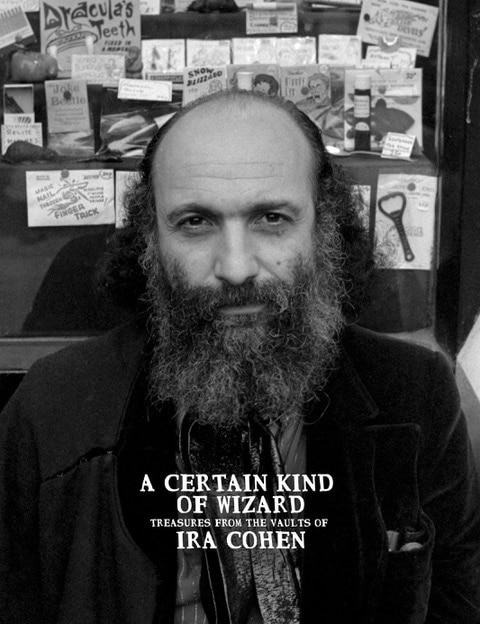
These prose texts, interviews, poems and photographs testify to the remarkable life and work of Ira Cohen, and provide a unique picture of the counterculture of the 1960s, ’70s and later. They reveal a way of being in the world which seems unattainable today — the freedom to cross geographical, political, cultural, linguistic and religious boundaries.
Ira played many parts in his time, he was a great performer — a poet by vocation, he was also a photographer, film maker, collage artist, magazine editor, publisher, scholar, actor, magician, story spinner, jazz afficianado, hipster, Great Rememberer, drug connoisseur, spiritual seeker, devotee of Dante, Rumi, Villon, Chatterton and Borges, mythographer, mythologizer, cabbalistic hermeticist, “Electronic Multi-Media Shaman,” and more — “Much more!”
This book documents and evokes Ira’s travels in India, Nepal and North Africa and his study of Hinduism, Islam, Buddhism, the Kabbalah, and occult lore. As he tells George Gatsas in an interview from 2003, he went in search of adventure, he was drawn to other cultures because “I knew them as a poet would know them — by reading poetry that comes from these places and mystical sources.” The counterculture then was community and connectivity, an open underground nexus based upon shared anti-establishment values and spiritual concerns, with its own potlach economy of exchange, hospitality and collaboration, and the little “samizdat'”magazines in which Ira’s work was initially published played a significant role. Included here are two important long poems of the counterculture: “The Stauffenberg Cycle,” written in 1977 in Germany at the time of the far Left Baader-Meinhof Group, a period of increasing militancy and paranoia, and “Notes Of An Alchemist,” from 1983, a celebration of creative and mystical communion in the New York avant-garde loft scene of the late 1960s.
The use of tape recorders was prevalent in the 1960s counterculture and was instrumental in the transmission and circulation of its values and ideas, and Ira appears as both interview subject and interviewer. He was drawn to “those with special knowledge,” exemplified by his interviews with Paul Bowles, Brion Gysin and Charles Henri Ford, inspirational writer-artists of an earlier generation. Ira admired two special “tape books,” William Burroughs’ The Job and Brion Gysin’s Here To Go, and the present book is in that special lineage — transcribed interviews interleaved with relevant written texts, combining the oral and textual impulses of Ira’s discourse, disseminating his ideas and telling the story of his life, his voice “rising up off the page.”
In a 1983 dialogue between Ira and Brion Gysin, Gysin several times wound back the tape and erased parts of the recording at random. Ira was alarmed and protested about the loss of some great material, but Gysin’s response couldn’t have been clearer: “When I say erase the word, I mean erase the fucking word — wipe it out.” For Ira, multiple time zones coexisted and radiated and converged in unwritten present and future time, but the past was irrevocable, incarnated in the Divine Word; it was sacred and must be preserved, and he often quoted the Zohar: “Words do not fall into the void.”
This kaleidoscopic compendium reflects the loves and passions of Ira’s life — listening to the Moroccan trance music of the Jilala, tracking the effects of smoking grass and taking LSD, mescaline and majoon, the wonders of mirror magic and storytelling, Duende and deep feeling in poetry, the religious devotion of sadhus in India, meeting William Burroughs in Tangier. . . Vivid, vibrant memories of Kathmandu, Tangier, Hardwar, Amsterdam, London, Paris, Okinawa, Bombay and Iraklion percolate through the book in a unique synthesis of travel writing, autobiography and prose poetry, Ira evoking place and time through sparkling, jewelled details and heady syntactic jumps in psychic flow, reportage in present time merging with the memories and mythos of vanishing worlds.
There were profound connections between his parents’ deafness and Ira’s visual art and his vocation as a poet, but he could never unravel these threads, or preferred not to. “I was a child of deaf parents,” he said, “I learned to spell on my fingers even before I could talk.” From a very early age he was the interpreter who translated and transmitted the hearing world for his parents, an intermediary between the world “out there” and the silent home, moving between silence and sound, signing and speech. Ira could talk for the world, but listening was important, too, as he had always “listened out” for his parents. “The sounds of the world caress the heart of my ear,” he said, like the sibilant message of the Tangier night when it whispered to him, “Con su permiso. . . “
In Nepal in the early 70s Ira’s partner Petra Vogt filled notebooks with her drawings and writings and Ira became increasingly drawn to the physical act of writing in notebooks; his distinctive script flowing across and around the pages. As in his childhood, reportage and reverie were uniquely intertwined and a poem could begin with “something that actually happened” or with the emergence of a talismanic phrase with a haunting audio-scriptoral insistence, the nucleus of elliptical juxtapositions and streaming associations. Ira’s urgent desire to read a written poem aloud and to give voice to his inner world is revealing, mirroring in reverse his childhood role. He would pay tribute to his mother, Faye, “who taught me how to speak / with my hands / in the language of love” and he would write in notebooks by hand the poems of love which he would then read aloud or “out loud internally.”
Ira’s Mylar photographs exemplify the psychedelic ’60s, but Ira believed that his images transcended mirror distortion as an analogue for drug trips. Rather, as he told fellow photographer Ira Landgarten, he felt he had opened “Pandora’s Box of Cosmic Imagery” and channeled “an unearthly beauty,” the thrilling manifestation of celestial spirits and demonic archetypes. His Mylar photographs were inextricably connected with his love of divination and scrying — mirror, candle flame and crystal gazing took him out of himself into a silent realm of slowly unfolding, transfixing visual enchantment. This process was intimately connected with Ira’s unique portrait photographs of the artists, actors and seekers he knew; his uncanny ability to capture poignant moments, expressive gestures and the mortal beauty of the human face.
In 1999, Ira told poet, translator and scholar John Solt that psychoactive drugs had affected his work “to the very core.” They helped him become aware of his natural synesthesia, driving the sensorial correspondences of his creativity through different media. They also played their part in Ira’s fascination with the Akashic Records, conceived as an immense astral photographic film and audio bank through which the entire history of human thought-forms and experiences may be read and heard. Ira wrote of “tongues quelled by history” and believed the Akashic gave “sky speech” to the deaf and speechless and to those silenced by oppressive regimes, and it corresponded with his own experience of “unattended moments” of transcendental awareness. Like William Burroughs, Ira recognized such experiences and their place in his thought and art was crucial.
Towards the end of his extraordinary life, Ira wrote that “greed has infected the human heart”, and he saw violence and degradation everywhere. He grieved and he suffered the Deep Blues, but he never gave up his lifelong quest for holistic pattern and spiritual meaning, and he continued to “seek the hidden treasure.” In his poem “Cat’s Cradle” he wrote: “Once on a dark night full / of glittering stars above the Coromandel coast / I looked up to see the sympathetic strings / red & blue, which held the sky / together by natural law. / I have never seen them since, / but I know they are still there.”
Ian MacFadyen,
London, April 2022