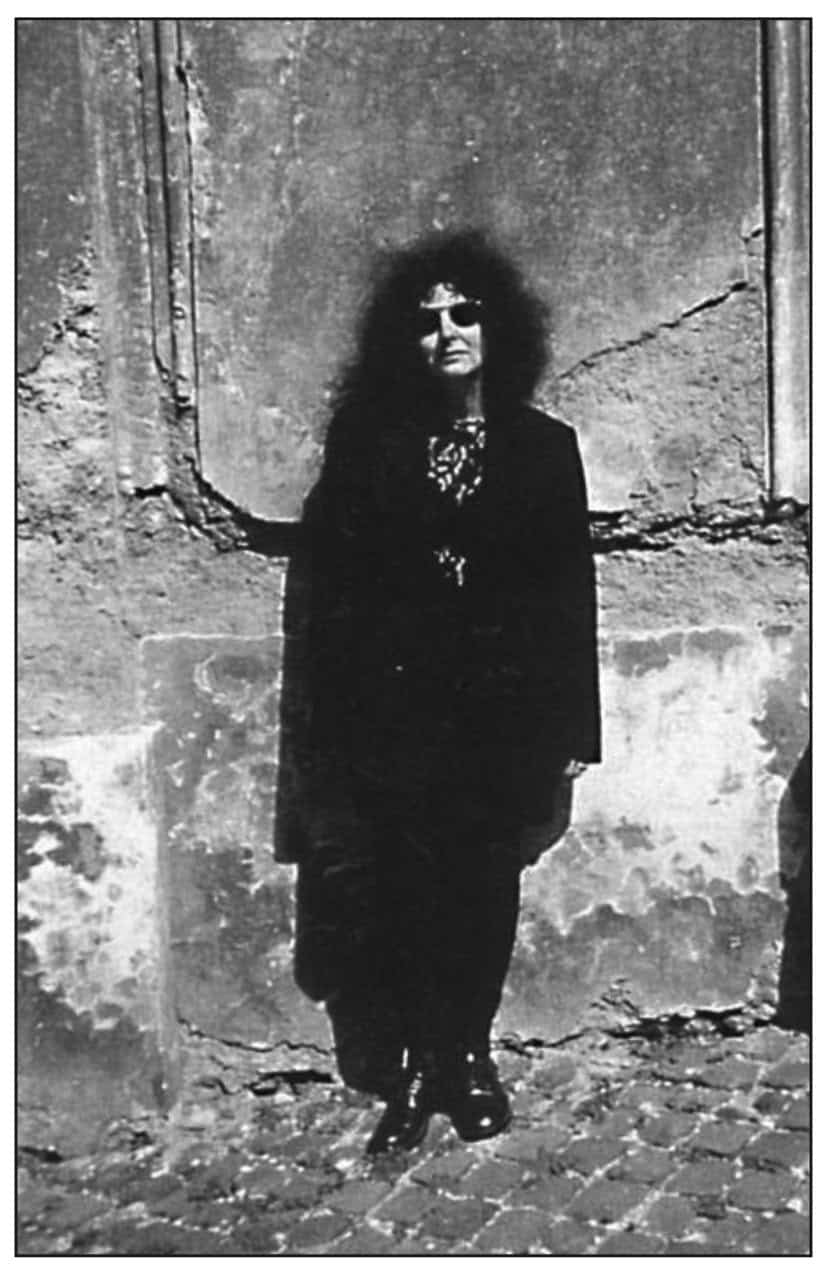
In Where I Stand in Angel, “Louise Landes Levi is ‘on the road.’ Nomadic & hermetic, exiled and initiated, she reveals both uninvited encounter & encounter with the marvelous through the poetics of collage, the cut-up of perceptual process.
Mostly untitled, the poems narrate dissociation but also pleasure, poetry as practice, as purification, itself a vehicle for the re-emergent feminine. (…)”
Vision and Duende in LLL’s Angel
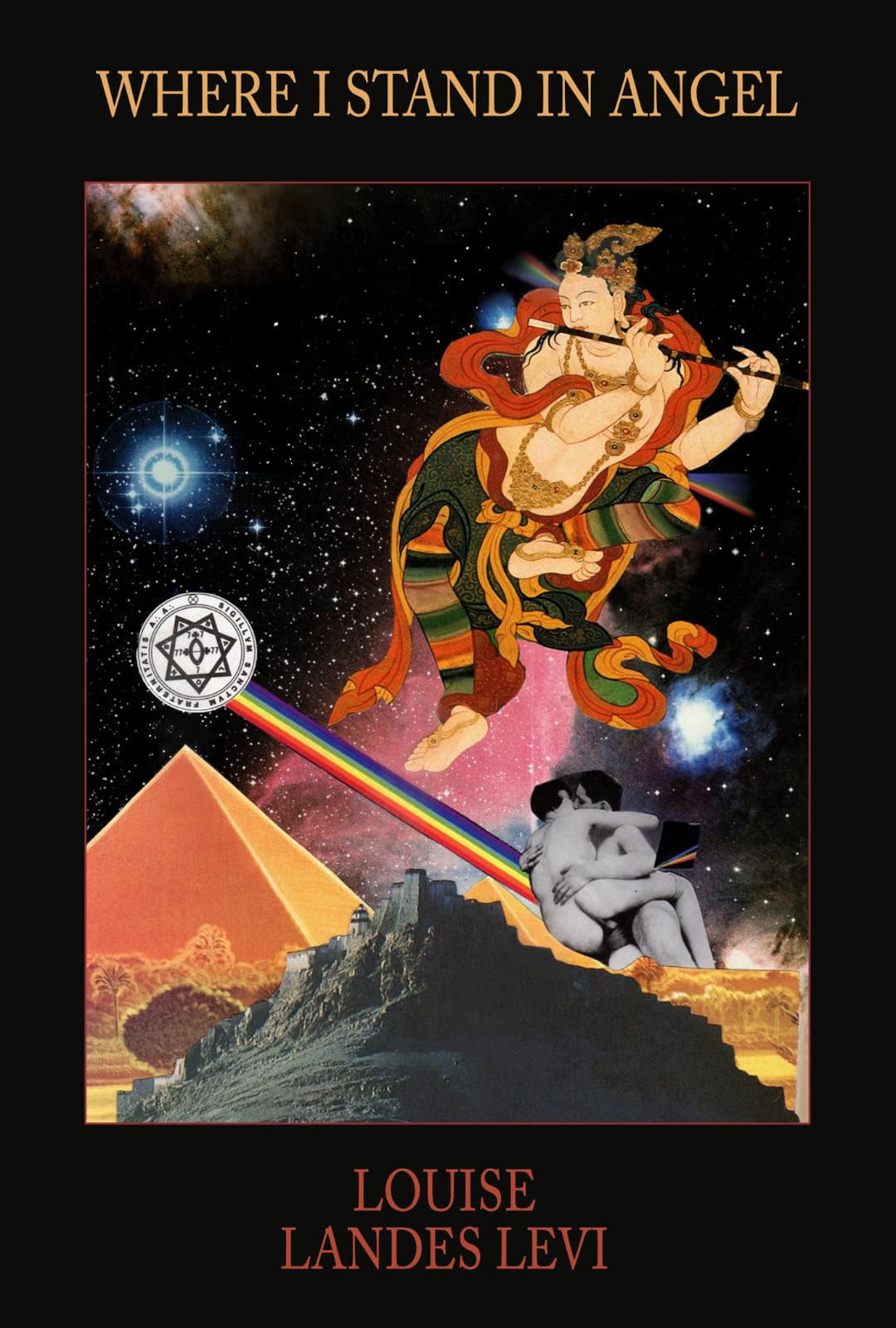
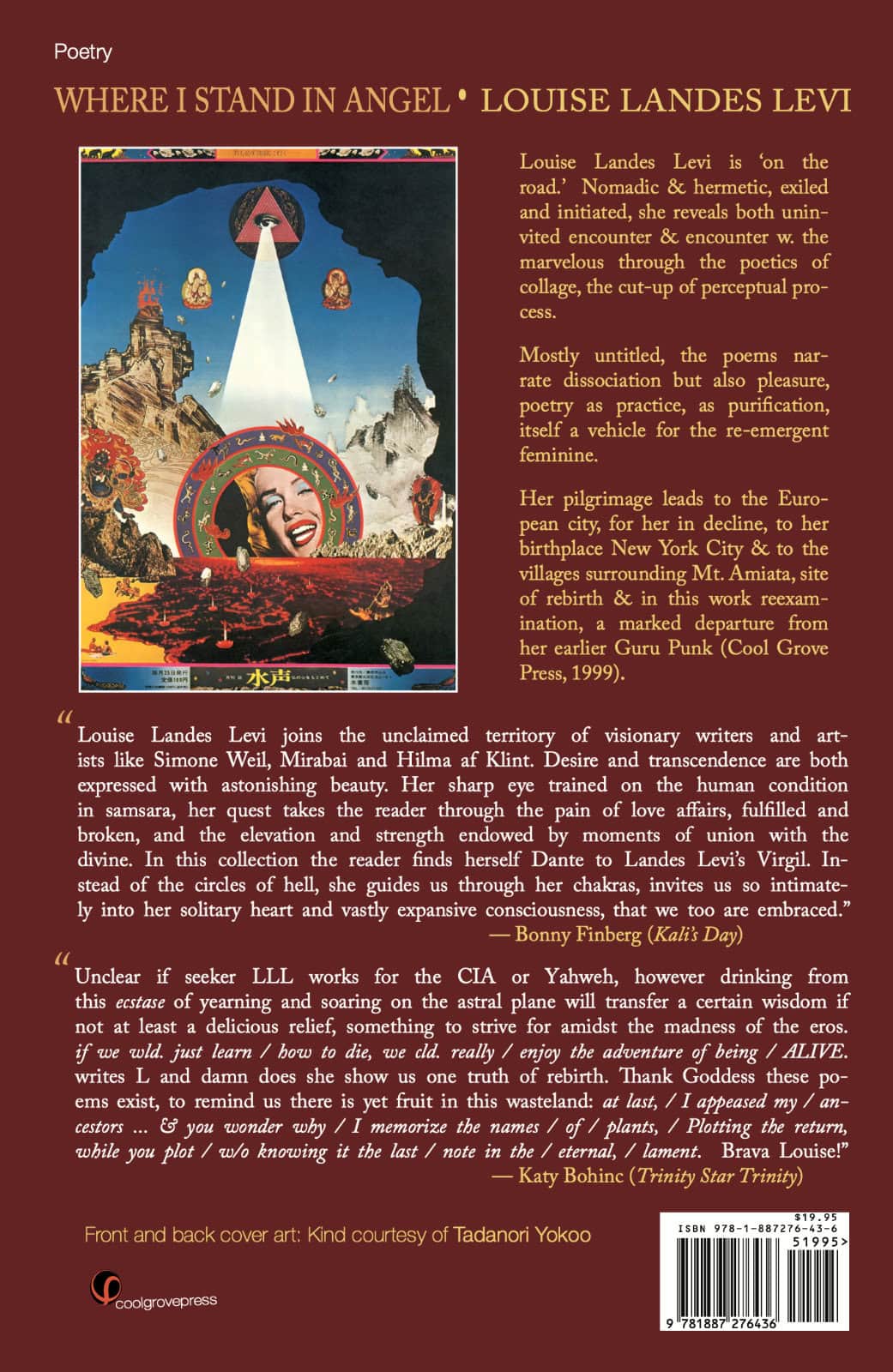
Louise Landes Levi’s Where I Stand in Angel (Coolgrove, 2024) announces itself, in its materiality, as a book of color, vision, and risk. Tadanori Yokoo’s front-cover collage triangulates Jindřich Štyrský’s dark eroticism in Emilie Comes to Me in a Dream with Hindu iconography and Aleister Crowley’s Seal of Babalon. I read Yokoo’s image as doing less to illustrate Louise’s poems than to map a charged field where method, eros, and danger converge. Once seduced into that triple limen, reading Louise comes not as interpretive but participatory.
The title Where I Stand in Angel is itself an out-loud declaration. This book belongs to the same lineage as Allen Ginsberg’s “Kaddish,” where the poet stands at the grave, eye buried, voice calling into Sheol. Like Ginsberg’s cawing cries and black-clouded Eye, Levi’s visions do not console so much as demand presence. The Underworld—announced on the back cover by Yokoo’s collage title, “You Will Definitely Go to Hell” (君も必ず地獄に行く)—appears here less as threat than as passage. A descent that renders knowledge concrete rather than abstract.
These poems insist on juxtaposition for method and exposure for insight. They also invite speculative reversals: What if the collagist were not Štyrský but Emilie herself? What if Kaddish were written from Naomi’s position rather than Allen’s? What if the Scarlet Woman, rather than Crowley, founded the Argenteum Astrum? Such questions are not provocative but structural. Angel re-centers vision from a feminized, embodied position, one dismissed within avant-garde and esoteric traditions. Levi’s stance has less in common with Surrealist urge than with ritual endurance. Where Štyrský’s dream erotics emphasize compulsive return, Levi’s dreamwork, modulated by Chöd practice and tantric descent, induces oblation. Experiences of loss, longing, lament are neither psychologized nor transcended; they are placed into the poem as material to be confronted and, symbolically, devoured. In Angel, the avant-garde and the hermetic are made answerable, but never renounced.
This is where the concept of “duende” becomes difficult to avoid. Federico García Lorca explained that duende does not come from above like an angel. Duende “rises from within, from the soles of the feet.” Levi’s poems are saturated with that energy. Her voice refuses safe distance; it remains in a zone where song entails struggle and vision is inseparable from wound. It is worth clarifying here that documenting injury and romanticizing pain are not one and the same thing. Duende, in this context, names neither aesthetic intensity nor inspiration, but the refusal to leave that struggle and that wound behind. Not just yet, for duende is about danger.
It is perhaps telling that Louise Landes Levi does not appear prominently in many collections of “women Beat writers.” Whether this absence reflects critical oversight or deliberate positioning is difficult to determine. What can be stated with confidence is that Levi’s work operates in direct continuity with Beat commitments to vision and lived practice. Her relative invisibility may be less a failure of recognition than a chosen condition. There is something persuasive in the suspicion that Levi occupies the role of a hidden master, a task that seems to suit both her work and its uncompromising demands. Standing “in Angel” is not elevation but a maintained position at the crossing of worlds, where insight must be earned. Few contemporary poetry books are willing to occupy this space. Fewer still can sustain it without spectacle. Where I Stand in Angel is not, finally, a book to be decoded. It is a rigorous poetic diary—ecstatic, uncompromising, and written with duende.
Antonio J. Bonome,
PhD Lecturer at Universidad Carlos III de Madrid and Beat Generation scholar.
About Louise Landes Levi
Poet, performer, translator and traveler, Louise Landes Levi was born in NYC, studied at the University of California and traveled to India, overland, in the late 60s. Her works on India, recognized classics, decades after their accomplishments — RASA by René Daumal and Sweet on My Lips: The Love Poems of Mirabi — are still in print.
An itinerant scholar & iconoclast, Levi continues to publish, self-publish*, write and wander, translating when requested or inspired and performing, in a wide variety of venues in USA, EU & Japan. She participated in the Burroughs Festival in 2010 University of London, Paris, where the booklet upon which her assertions in the introduction (to this book) were first presented.
A student of Namkhai Norbu Rinpoche for the final 4 decades of his life, she expresses deep gratitude to him for his immeasurable kindness to her. Recent publications include Banana Baby (Supernova, 2006), The Book L (Cool Grove, 2010), Love Cantos 1-5 (Jack in Your Box, 2012), From The Ming Oracle (Sloowax, 2014), Crazy Louise or La Conversazione Sacra (Station Hill, 2018), The Orgasmic Nations (Ragged Lion, 2020) and Behind the Buddha’s Mask (Counter Cultural Chronicles, 2021). Single poems, chapbooks, interviews and reviews are online at Otoliths, Big Bridge, Unlikely Stories, The Brooklyn Rail, The Mirror, Wire and at the Cool Grove Press website. Recent spoken word cassettes: Sacred Remains in the Transformation Station, No Further Than the Nightingale, Opacity and Oblivion. Recent LPs: Ikiru, Kami and Mad Song.
* Levi directs Il Bagatto Press, which originally published ANGEL in an edition of 16 copies, 2 of which are in the Tadanori Yokoo Museum, in Kobe, Japan.