Of Interest

A review of two books from Shivastan Press

by Louise Landes Levi

This review was previously published in Otoliths and is posted here courtesy of Louise Landes Levi.

Independent publishing is an increasing rarity in the corporate dimension in which we are, by the merciless law of the state & the state of affairs in the new millennium, compelled to live and hopefully, despite obstacles, to evolve. Shivastan Press, w. books printed in Katmandu, Nepal & distributed fr. Woodstock, NY, is the rare exception, printing handcrafted finely-illustrated chapbooks by some of the finest poets of our times, both those known & those lesser known.

Ira Cohen has an international reputation as film maker, photographer, story teller & eclectic poet. The treasury of images & the symbolic correspondences to which his mind seems so particularly adapted have found their way into esoteric collections around the globe, but if one is not in the privileged situation of being his friend, his work is not that easy to access. Large collections of his photography are now being published, one, albeit in Germany, Up Close & Personal (Papageien Verlag); but, regrettably, no inclusive collection of his poetry is as yet forthcoming. Each of his chapbooks thus offers a rare glimpse of the poet’s mind, his dedication to the muse & his insight into the mysteries exceeding her.

Whatever You Say May Be Held Against You, handwritten on Nepalese rice paper, is illustrated w. the author’s portrait of Allen Midgette, “the last of the moccasins” (to whom the book is dedicated), several of the poet’s own collages in black & white & a portrait of the poet by Marco Bakker handsomely printed on the black back cover of the rice paper book.

The poems span a broad time cycle, beginning w. Cohen’s seminal work in Katmandu fr. the mid to late seventies, where he also fathered Bardo Matrix Press, in some ways the predecessor to Shivastan, the one in which his work is now represented.

fr. Himalayan Journey

After 15 days/ walking in the Himalayas/we arrive at a strange place (Seta Gompa)/ at nightfall/ my head is empty of all thought/ as I enter the Lama’s room/ filled with great cauldrons/ & charred pots,/ golden ochres,/ Rembrandt browns/ the wood of demon masks/ gleaming under layers of/ smoke & butter/ Outside as the light breaks/ clouds above & below/ like a domed ceiling/ painted by Tiepolo.

Later & more recent poems concern the national & international crisis of 9/ll—(Cohen’s girlfriend is visiting & dreams about the catastrophe the night before it occurs.)

fr. Today’s Headline (May 20 2002)

There’s a sucker born every minute/ is the credo of capitalism/The Age of Reason has come/ & gone/ with the wigs of/ authority & self interest/ It’s not them, it’s US

& the general artistic milieu of NYC, or what’s left of it, when Cohen returns to his mother’s apartment on 106th & Broadway after years of world travel

fr. A Concert of Evening Ragas, in memoriam Pandit Pran

The discovery of poetry as an art of swimming/lucid breath in transparent water/ ...No fear of drowning/ in this ocean of sound.

Many of Cohen’s closest associates—Sheldon Rochlin, Vali & of course Angus MacLise—are given complex & sweet farewell by the poet who eulogizes them. At the same time, he prepares his own mind, w. a warmth that exceeds conjecture, for the inevitable.

fr. Creeley’s Poem

by the time you figure this, that will overtake you/ archaic wonders, my ass, it’s the last inning. Time for some heroics/ Fame is faint in the mirror/ the man in black is my affinity.

Cohen has escaped category & has reason to both rue & celebrate his isolation. I was happy to see a generous selection of his poetry included in Chris Felver’s BEAT & recommend Whatever You Say to those unfamiliar with his work & also, of course, to those who have read his other recent chapbook, Chaos & Glory ( Elik Press). His aggressive script on delicate lokta rice paper will add an additional level of intimacy to the contemplation of his multi cultural & luminous poetic inquiry.

fr. Lost Words

It is the eye of the spirit which opens under water/when you seek you will not find me./ I am already here.

Whatever You Say is a collector’s item.

Shivastan has also published Laynie Browne’s evocation of the perennial philosophy, Original Presence, as part of its wide reaching publication &, in some cases, republication of esoteric works in the context of the late 20th century & the early millennium. Many of its authors—Anne Waldman, Peter Lamborn Wilson, Janine Pommy Vega—spent decades studying & traveling in the Far East, The Middle East & Asia in efforts to comprehend the roots of disaster in the occidental worlds & to first hand, absorb the last traces of the wisdom cultures of the East, even those threatened by consuming winds.

Laynie Browne & her contemporaries, Juliana Spahr, Lee Ann Brown et.al., born in the generation following the above-mentioned, did not take to the road, but stood firm, in their endeavors to create a post-beat sensibility & a new voice with which the greater Feminine might express itself. A generation of women writers emerged in America, 1985 & onward, for whom the Beat generation was NOT a major reference but whose model of collaboration & mutual sustenance nevertheless informed it.

In Original Presence, Laynie travels inward. The book is dedicated to Avram Davis, & the Cabalistic axis upon which the poetic intonation is turning & to which it is tuned is unmistakable. The book is again printed on rice paper & is illustrated w. surreal & poignantly detailed collage by Toni Simon, an illustrator of other works by Brown, Web of Argiope (Phylum Press) & Pollen Memory (Tender Buttons).
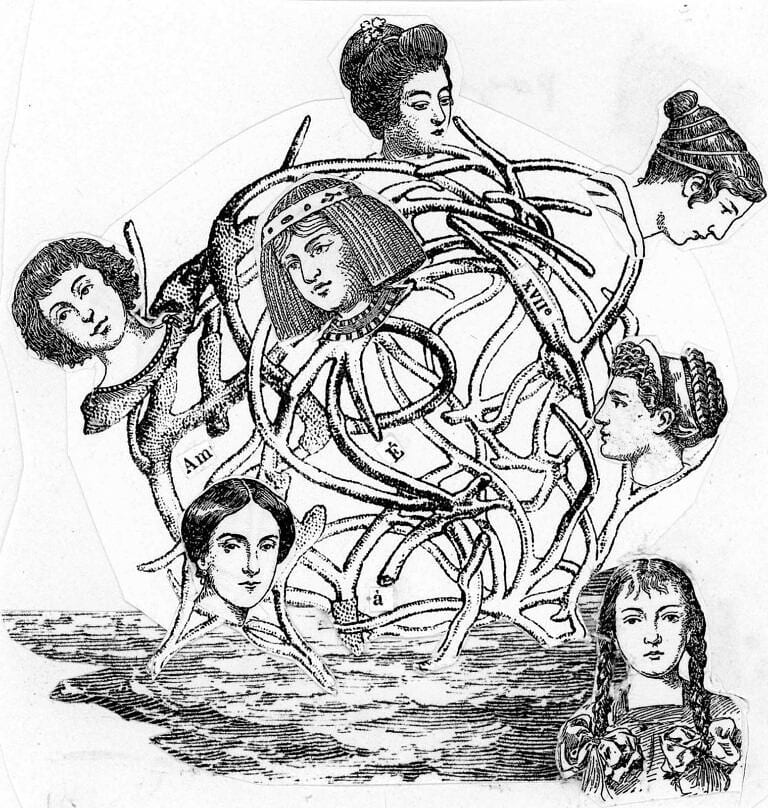
Toni Simon: Girls’ Faces

Original Presence is divided into 3 parts: The Girl of Salt, A Quiet Flame & Sudden Inscription. Laynie’s exquisite line, her ability to condense her voice into near crystalline essence is evident through out.

I went to see the girl of salt/ She gave herself to water-/She gave herself to question/ She was nowhere apparent & yet I went to her

Laynie defines, redefines & undefines her search.

The salt girl can reconstitute hersellf and leave the sea/ girl of wax/ girl of paper/ not the watcher/ but the center…

Brown makes indirect reference to hermetic teachings & their language systems but does not depart fr the stylistic innovations that qualify the aesthetic formulations of the century she inhabits. The tensions between the urgency of her meditation, the maintenance of her personal linguistic & the richness of the metaphor she inherits formulate the matrix & mysterious lucidity of this text.

Quiet Flame introduces substance to the seeker’s domain

the candle alone shines of itself and for itself/ practice of the maiden’s chamber/wherever the line is the sand

whereas in Sudden Inscription

Nevertheless, my closed eyelids are encoded with breathing letters/Do you say then language is a garb? A cloth with which to cover the raw head of vowels?

the author reclaims her autonomy.

You write upon my hand as if to say/ Come goblet, come fixture of mind/ Remember the liquid cunning of the sky/Return to my uniform of hands/ pressed upon you/ allowing you to stand.

One reads this book in acrobatic suspension,. sustained in a visionary apparatus, that like all true poetry, is nevertheless tuned to the fundamental of the human harmonic & to its form.

Brown is a master of the postmodern school & sensibility. Those who have followed her work—Rebecca Letters (Kelsey Str.), The Agency of Wind (avec) & Gravity’s Mirror (Primitive Press) et.al.—understand this. In Original Presence we are introduced to an esoteric journey. Brown crosses the divide bringing her study of ancient text to intimate contemporary presence.
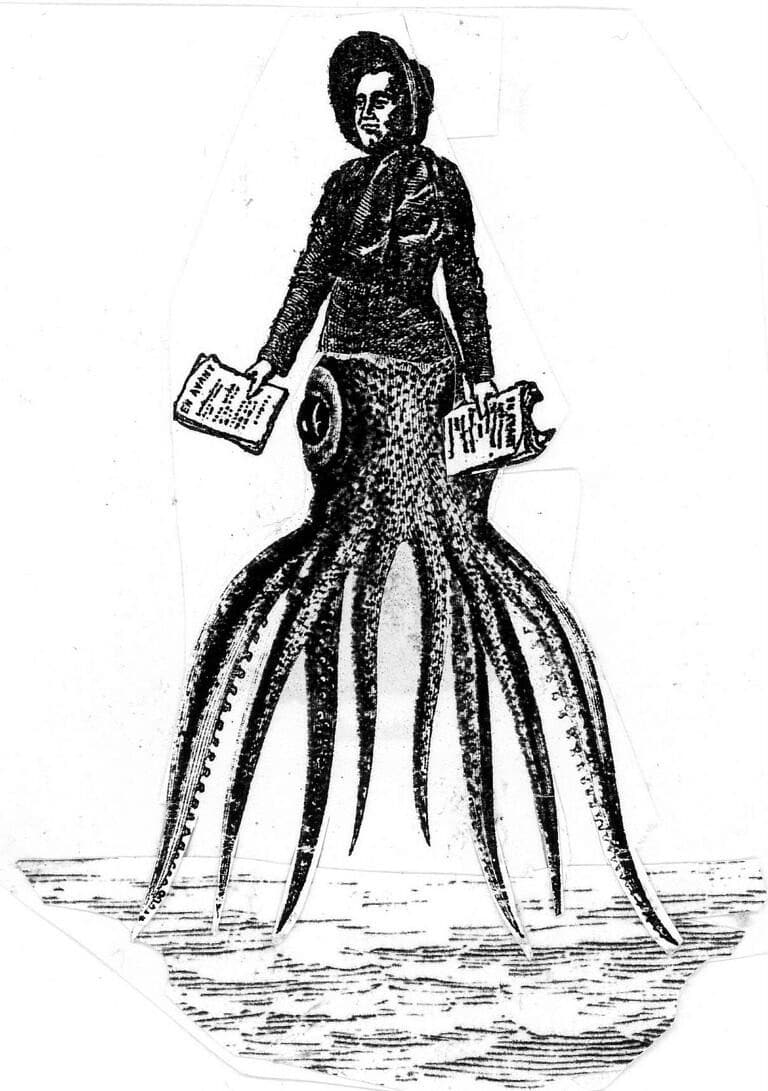
Toni Simon: Octopus Woman

Typed script & surreal image, printed on the blankness—at times almost textual—of the rice paper page, bring a third element to the visual field, at times dissolving it completely.


Louise Landes Levi’s The Deep Diamond, portions of which were included in issue two of Otoliths, is forthcoming as a Shivastan broadside.

Shivastan Press books are craftprinted in limited editons of 333 copies in Kathmandu, Nepal, & are distributed by the publisher, Shiv Mirabito, 54 Tinker Street, Woodstock, NY 12498.

A selection of Ira Cohen’s poetry, On Feet of Gold (poems 1968-87), was reprinted in connection w. a photography retrospective at the OCTOBER GALLERY, London, Nov. 2007 – Feb. 2008, & can be ordered on line from the publisher, Synergetic Press.

Laynie Browne´s latest book is Daily Sonnets, published by Counterpath Press, Denver.
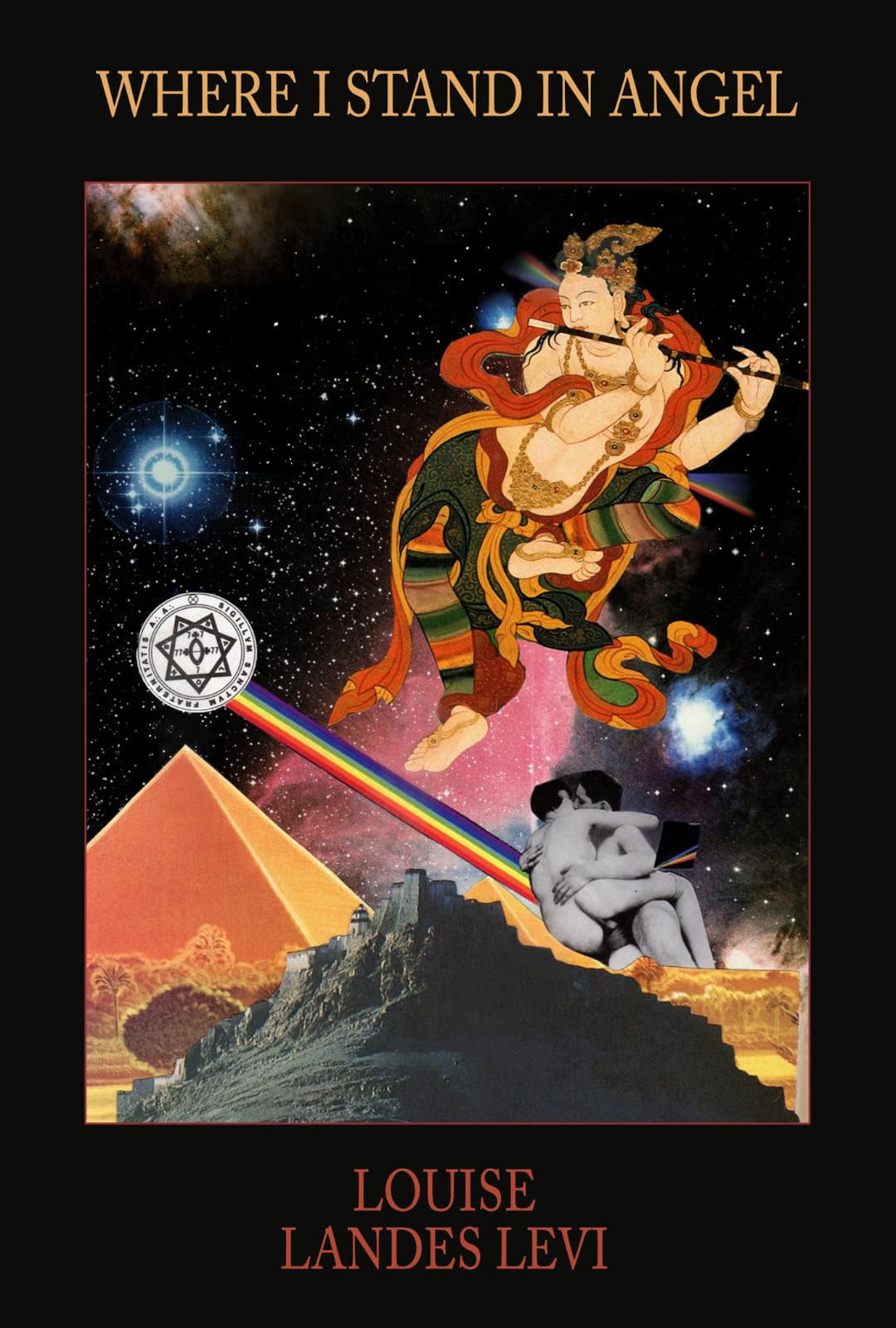
Where I Stand in Angel by Louise Landes Levi

In Where I Stand in Angel, “Louise Landes Levi is ‘on the road.’ Nomadic & hermetic, exiled and initiated, she reveals both uninvited encounter & encounter with the marvelous through the poetics of collage, the cut-up of perceptual process.

Mostly untitled, the poems narrate dissociation but also pleasure, poetry as practice, as purification, itself a vehicle for the re-emergent feminine. (…)”


Vision and Duende in LLL’s Angel

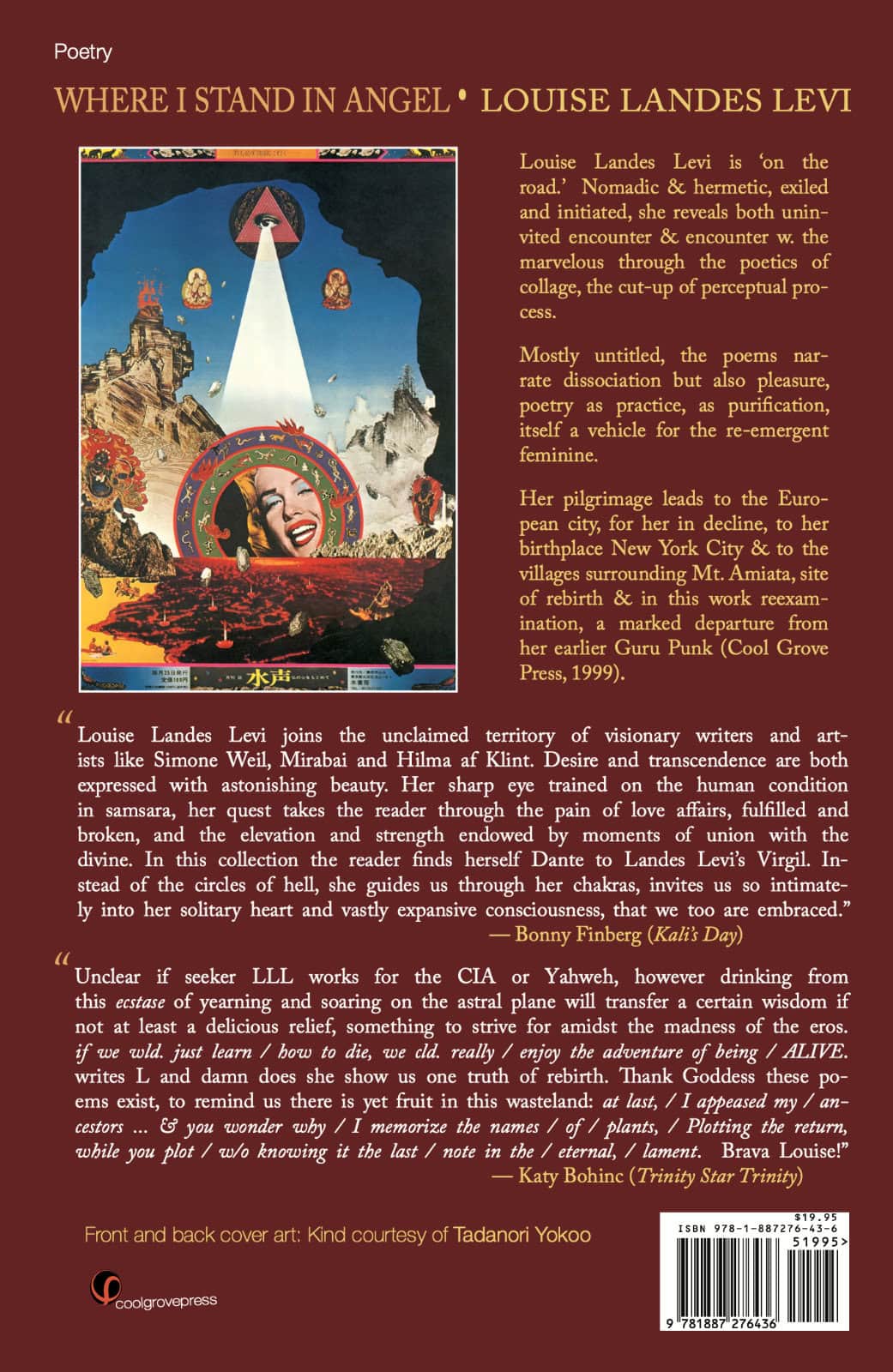
Louise Landes Levi’s Where I Stand in Angel (Coolgrove, 2024) announces itself, in its materiality, as a book of color, vision, and risk. Tadanori Yokoo’s front-cover collage triangulates Jindřich Štyrský’s dark eroticism in Emilie Comes to Me in a Dream with Hindu iconography and Aleister Crowley’s Seal of Babalon. I read Yokoo’s image as doing less to illustrate Louise’s poems than to map a charged field where method, eros, and danger converge. Once seduced into that triple limen, reading Louise comes not as interpretive but participatory.

The title Where I Stand in Angel is itself an out-loud declaration. This book belongs to the same lineage as Allen Ginsberg’s “Kaddish,” where the poet stands at the grave, eye buried, voice calling into Sheol. Like Ginsberg’s cawing cries and black-clouded Eye, Levi’s visions do not console so much as demand presence. The Underworld—announced on the back cover by Yokoo’s collage title, “You Will Definitely Go to Hell” (君も必ず地獄に行く)—appears here less as threat than as passage. A descent that renders knowledge concrete rather than abstract.

These poems insist on juxtaposition for method and exposure for insight. They also invite speculative reversals: What if the collagist were not Štyrský but Emilie herself? What if Kaddish were written from Naomi’s position rather than Allen’s? What if the Scarlet Woman, rather than Crowley, founded the Argenteum Astrum? Such questions are not provocative but structural. Angel re-centers vision from a feminized, embodied position, one dismissed within avant-garde and esoteric traditions. Levi’s stance has less in common with Surrealist urge than with ritual endurance. Where Štyrský’s dream erotics emphasize compulsive return, Levi’s dreamwork, modulated by Chöd practice and tantric descent, induces oblation. Experiences of loss, longing, lament are neither psychologized nor transcended; they are placed into the poem as material to be confronted and, symbolically, devoured. In Angel, the avant-garde and the hermetic are made answerable, but never renounced.

This is where the concept of “duende” becomes difficult to avoid. Federico García Lorca explained that duende does not come from above like an angel. Duende “rises from within, from the soles of the feet.” Levi’s poems are saturated with that energy. Her voice refuses safe distance; it remains in a zone where song entails struggle and vision is inseparable from wound. It is worth clarifying here that documenting injury and romanticizing pain are not one and the same thing. Duende, in this context, names neither aesthetic intensity nor inspiration, but the refusal to leave that struggle and that wound behind. Not just yet, for duende is about danger.

It is perhaps telling that Louise Landes Levi does not appear prominently in many collections of “women Beat writers.” Whether this absence reflects critical oversight or deliberate positioning is difficult to determine. What can be stated with confidence is that Levi’s work operates in direct continuity with Beat commitments to vision and lived practice. Her relative invisibility may be less a failure of recognition than a chosen condition. There is something persuasive in the suspicion that Levi occupies the role of a hidden master, a task that seems to suit both her work and its uncompromising demands. Standing “in Angel” is not elevation but a maintained position at the crossing of worlds, where insight must be earned. Few contemporary poetry books are willing to occupy this space. Fewer still can sustain it without spectacle. Where I Stand in Angel is not, finally, a book to be decoded. It is a rigorous poetic diary—ecstatic, uncompromising, and written with duende.

Antonio J. Bonome,
PhD Lecturer at Universidad Carlos III de Madrid and Beat Generation scholar.


About Louise Landes Levi

Poet, performer, translator and traveler, Louise Landes Levi was born in NYC, studied at the University of California and traveled to India, overland, in the late 60s. Her works on India, recognized classics, decades after their accomplishments — RASA by René Daumal and Sweet on My Lips: The Love Poems of Mirabi — are still in print.

An itinerant scholar & iconoclast, Levi continues to publish, self-publish*, write and wander, translating when requested or inspired and performing, in a wide variety of venues in USA, EU & Japan. She participated in the Burroughs Festival in 2010 University of London, Paris, where the booklet upon which her assertions in the introduction (to this book) were first presented.

A student of Namkhai Norbu Rinpoche for the final 4 decades of his life, she expresses deep gratitude to him for his immeasurable kindness to her. Recent publications include Banana Baby (Supernova, 2006), The Book L (Cool Grove, 2010), Love Cantos 1-5 (Jack in Your Box, 2012), From The Ming Oracle (Sloowax, 2014), Crazy Louise or La Conversazione Sacra (Station Hill, 2018), The Orgasmic Nations (Ragged Lion, 2020) and Behind the Buddha’s Mask (Counter Cultural Chronicles, 2021). Single poems, chapbooks, interviews and reviews are online at Otoliths, Big Bridge, Unlikely Stories, The Brooklyn Rail, The Mirror, Wire and at the Cool Grove Press website. Recent spoken word cassettes: Sacred Remains in the Transformation Station, No Further Than the Nightingale, Opacity and Oblivion. Recent LPs: Ikiru, Kami and Mad Song.

* Levi directs Il Bagatto Press, which originally published ANGEL in an edition of 16 copies, 2 of which are in the Tadanori Yokoo Museum, in Kobe, Japan.

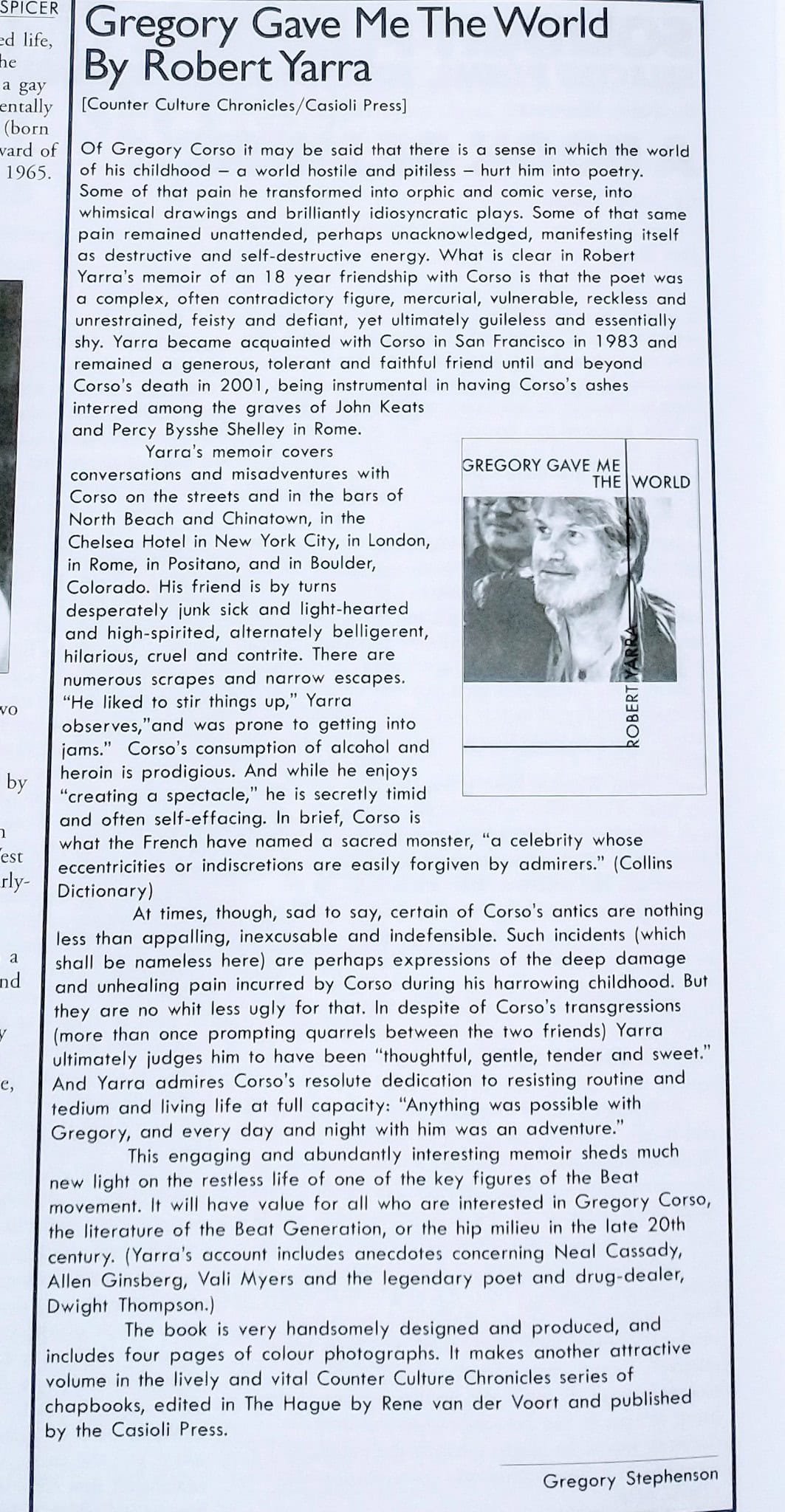
A review of Gregory Gave Me the World

A review of Gregory Gave Me the World by Robert Yarra

“This engaging and abundantly interesting memoir sheds much new light on the restless life of one of the key figures of the Beat movement.”

–Gregory Stephenson
Read the review

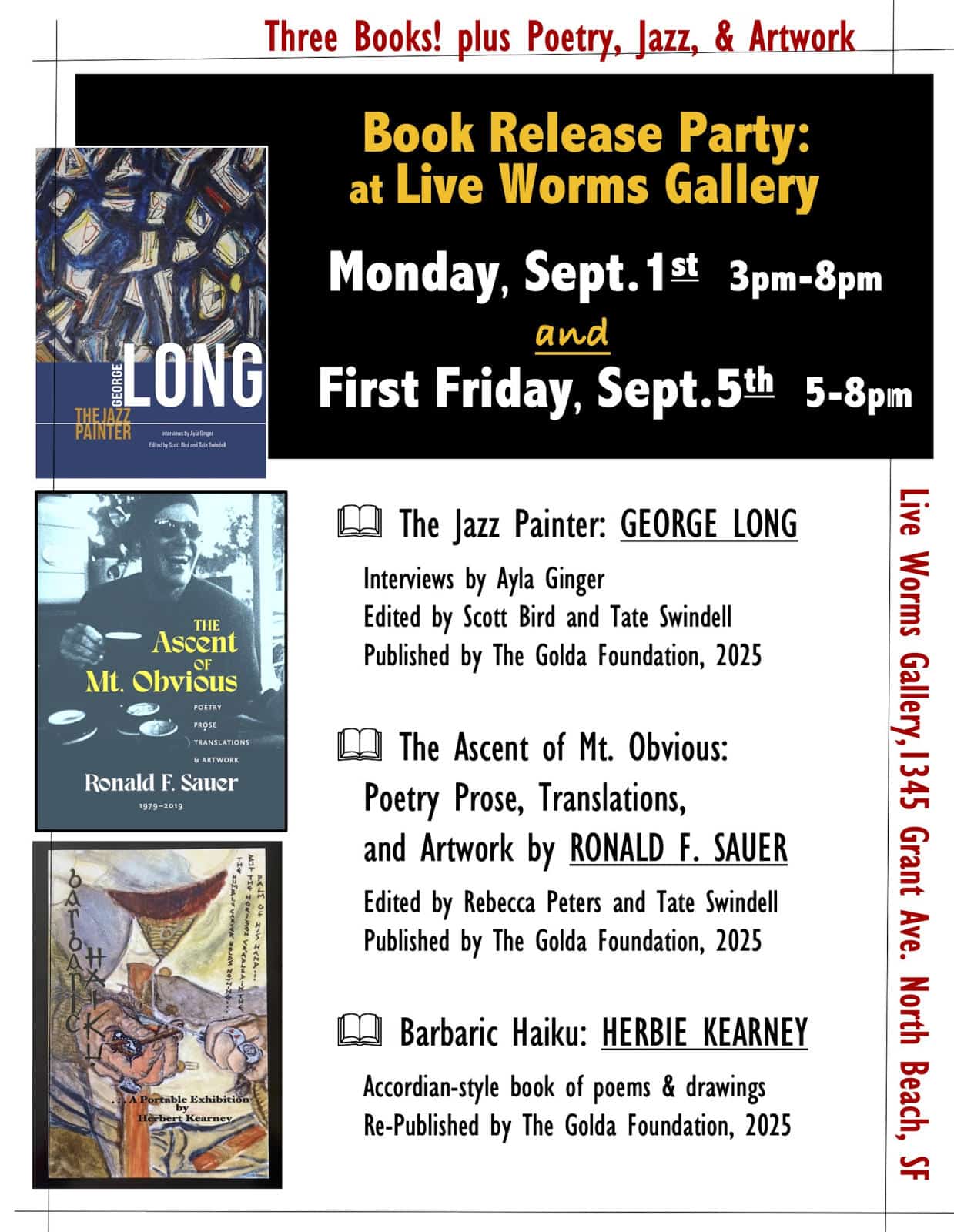
3 Book Release Party

Book Release Party for:

  • The Jazz Painter by George Long
    Interviews by Ayla Ginger
  • The Ascent of Mt. Obvious by Ronald F. Sauer
    Poetry, prose, translations and artwork
  • Barbaric Haiku by Herbie Kearney
    an accordion-style book of poems and drawings, republished by Golda Foundation

On Monday 1 September 2025 from 3 – 8pm
and Friday 5 September 2025 from 5 – 8pm

We’ll be celebrating with poetry, jazz and artwork at
LIVE WORMS GALLERY
1345 Grant Avenue, San Francisco — Map

Read about the books

A conversation about A Certain Kind of Wizard

Please join City Lights bookstore on August 19, 2025, in the virtual world, as Ira Landgarten and Tate Swindell discuss the life and work of Ira Cohen. We are celebrating the release of A CERTAIN KIND OF WIZARD – a dual publication from Lithic Press and Golda Foundation. Please note this is NOT an in-store event & you will need to REGISTER HERE for the Zoom broadcast. It begins at 6pm SAN FRANCISCO TIME. It will be recorded and posted online, eventually. You can turn your camera on or off, and you will be muted by City Lights. 

A Review of Pyramid of Fire

A review of Pyramid of Fire: The Lost Aztec Codex: Spiritual Ascent at the End of Time by John Major Jenkins and Martin Matz

“Indeed, this book, with the beautiful introduction extracted from the works of Aldous Huxley, might be required reading to those traveling to Margarita Island. Not only does it reveal in initiatory tradition in the past of the same people among whom one is living, the Arimacoa, it signals the loss which this community has & is experiencing.”

–Louise Landes Levi
Read the review

Bowery Poetry Club Celebration of Ira Cohen

It was a wonderful evening of readings and remembrances at the Bowery Poetry Club to celebrate Ira Cohen’s life and work.

May 14, 2025, hosted by Tate Swindell with readings by
Timothy Baum, Karen Butcher, Lila Dlaboha, Hamid Idrissi, Baba Ben Israel, Shiv Mirabito, Valery Oisteanu, Ondi, Chris Rael & Danny Rosen.

Ira Cohen tribute 5-14-25 Bowery Poetry Club, NYC
Video by Robert O’Haire

A Certain Kind of Wizard Celebration

Please join us to celebrate Ira Cohen in NYC

There will be poetry and poetic remembrances, photographs, film clips, music and more. Refreshments will be provided.

Wednesday May 14th, 2025 at 7pm
Bowery Poetry Club at 308 Bowery, NYC

Thursday May 15th, 2025 at 7pm
The Bunker at 222 Bowery, NYC

Poet, photographer, filmmaker, publisher, and dauntless world traveler, Ira Cohen was a mythic figure of boundless energy who was a catalyst for creative scenes in New York, Tangier, Kathmandu, Amsterdam, and wherever else he happened to alight in his wanderings. Cohen knew the best and the brightest — William Burroughs, Gregory Corso, Vali Myers, Brion Gysin, Paul Bowles, Charles Henri Ford, and so many others. Filmmaker Jack Smith, Julian Beck and Judith Malina of The Living Theatre were close friends and collaborators on many projects. A Certain Kind of Wizard includes Cohen’s poetry, photos, interviews, and prose writings from his remarkable journals.

A Review of Time Waits

A review of Time Waits: Selected Poems 1956 – 1986 by Martin Matz

“Matz at times comes close to reaching the breath-taking heights that Kaufman achieved in his great works of poetry, especially his final work, The Ancient Rain, but there is something distinctive and slightly haunting about his style. It reaches deep into the cosmos (outer space) and also down into the innermost recesses of the poet’s own self (inner space) and the imagery jumps from one luxuriant image to the next, in a psychedelic ‘feast’ of images that coalesce into a whirlwind, a swirling chiaroscuro of colors, like the colors that grace the cover of this book, that build upon each other, and reflect or refract previous images. The effect is both hypnotic and captivating to the reader who is under its spell.”

–Matthew James Mclaughlin
Read the review

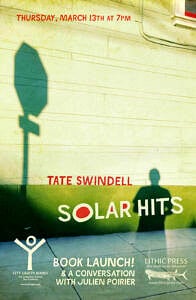
Solar Hits by Tate Swindell

Solar Hits is the first full length collection of poems by San Francisco poet Tate Swindell, an archivist, poet photographer, and founder of Unrequited Records.

The book launch will be at City Lights on March 13 at 7PM. There will be a brief conversation with Julien Poirier followed by a reading from the book. The event will be streamed by City Lights. You do not need to pay anything to Eventbrite to register for the event.

Link to pre-order the book from Asterism distro

Link to register for the City Lights stream